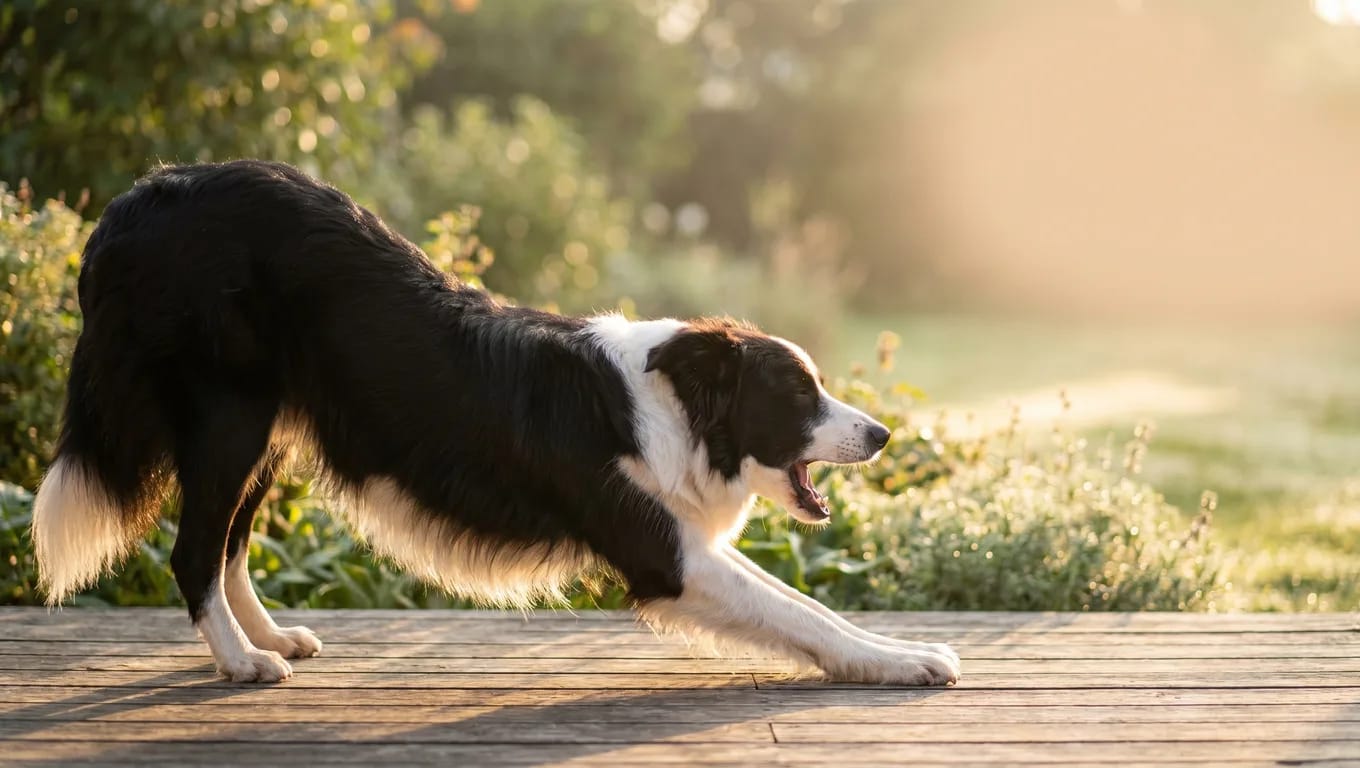
You walk through the door after work and your dog peels itself off the floor, plants its front paws forward, drops its chest toward the ground, and pushes its back end into the air. Tail loose, eyes soft, a long satisfied exhale. A few seconds later it shakes off and trots over to say hello. Most of us see that stretch a hundred times a week and never think twice about it.
But once you start watching closely, questions creep in. Why does my dog keep stretching the moment I look at it? Is it a greeting, a yawn for the body, or is something actually sore? This guide walks through what dog stretching really means, when it is completely normal, and the specific signs that turn an ordinary stretch into something worth a vet visit. We will finish by turning that everyday habit into something genuinely useful: a proper warm-up for an active dog.
What Does Dog Stretching Mean?
The short version of dog stretching meaning is that one movement can carry several messages depending on context. The same stretch might be a hello, an invitation to play, or just a dog loosening up after a nap. Telling them apart comes down to the situation around it: who is there, what just happened, and what the rest of the body is doing. Here are the most common reasons a healthy dog stretches.
A greeting
A lot of dogs stretch directly at you. You make eye contact, they front-paw forward into a long bow, then come over wagging. Trainers often call this a greeting stretch or "puppy bow," and it tends to show up right when you wake up, walk in the door, or finish a phone call and finally pay attention to them. It is friendly, relaxed body language: loose tail, soft mouth, no tension. In plain terms, it means "hi, I'm glad you're here."
A play bow
The classic play bow looks almost identical to a greeting stretch, front end down, back end up, but it carries a different intent. It is an invitation. Dogs use it with each other and with us to say "this is a game, whatever happens next is friendly." You will usually see it paired with a bouncy spring, a play face, maybe a bark, and then a dash away to start the chase.
The giveaway is energy and rhythm. A play bow is springy and repeats; a greeting or comfort stretch is slow and settles into a relaxed stand.
Comfort and waking up
This is the most common one of all. After lying still, a dog's muscles and joints stiffen slightly, and stretching restores blood flow and range of motion, exactly like the long reach you do before getting out of bed. You will see it most after naps, in the morning, and after a car ride. A comfort stretch is unhurried, often comes with a yawn, and frequently ends in a full-body shake.
A stress reset
Stretching and a big shake-off can also be a way for a dog to release tension and reset after something mildly stressful, like a tense moment at the vet, an awkward greeting with another dog, or a startling noise. On its own this is healthy self-regulation. It only matters when you see it stacked with other stress signals: lip licking, yawning out of context, a tucked tail, or turning away.
Context is everything. The same stretch is a happy greeting at the door, a "let's play" bow in the yard, and a quiet reset after a stressful moment. Before you read meaning into the movement, look at the whole dog and what just happened around it.
Why Does My Dog Keep Stretching?
If you have typed "why does my dog keep stretching" into a search bar, you are usually asking one of two very different questions: is this just a personality quirk, or is my dog trying to tell me something hurts?
For most dogs, frequent stretching is simply normal. Some individuals are naturally more "stretchy" than others, the same way some people crack their knuckles or roll their shoulders all day. A dog that stretches every time it gets up, greets you with a bow, and loosens off after every nap is almost certainly just being a dog.
The picture changes when the stretching looks less like a choice and more like a response to discomfort. The key is what kind of stretching, and what else is going on at the same time.
The "prayer position" is worth knowing
There is one specific posture that deserves its own mention. If a dog repeatedly drops its chest and front legs to the floor while keeping its back end up in the air, and it holds that position rather than springing out of it, that is sometimes called the prayer position (or "praying position"). It can look just like a play bow, but the intent is the opposite: it is a way to relieve abdominal pain by stretching the belly.
The difference is everything we talked about above. A play bow is brief, bouncy, and clearly social. A pain-driven prayer position is repeated, held, and comes with no playful energy, often alongside a hunched back, restlessness, refusing food, a swollen or tight belly, or unproductive retching.
A repeated, held "prayer position" with a tense or swollen abdomen, retching without bringing anything up, pacing, and obvious distress can be a sign of bloat (gastric dilatation-volvulus), which is a life-threatening emergency. If you see this combination, treat it as urgent and contact your vet or an emergency clinic immediately. Do not wait to see if it passes.
Dog Stretching a Lot: Normal or a Warning Sign?
So your dog is stretching a lot. How do you tell the everyday kind from the kind that needs attention? The honest answer is that you cannot judge the stretch in isolation. You judge the pattern and the company it keeps.
Use this as a rough guide.
| Signal | Usually normal | Worth a closer look |
|---|---|---|
| Timing | After naps, mornings, greetings, before play | Out of nowhere, repeatedly, when settling should be easy |
| Body language | Loose, soft, ends in a shake and a relaxed stand | Tense, hunched, guarding the belly, reluctant to lie down |
| Posture | Brief, springy, fluid | Held position, repeated "prayer," stiff or careful movement |
| Mood and appetite | Bright, eating normally, keen to move | Withdrawn, off food, restless, whining, or pacing |
| Pattern | A lifelong, consistent habit | A new behavior, or a clear change from your dog's normal |
The single most useful word in that table is change. You know your dog better than anyone. A new stretching habit, a stretch that suddenly looks effortful, or stretching that arrives alongside any of the warning signs above is your cue to book a vet check rather than guess.
When to call the vet
Reach out to your vet if the stretching comes with any of these:
- A hunched back or an obvious guarding of the belly
- A tense, swollen, or painful abdomen
- Repeated retching or trying to vomit without success
- Stiffness, limping, or visible reluctance to get up, lie down, or use stairs
- Loss of appetite, low energy, or a clearly withdrawn mood
- Any sudden, marked change from how your dog usually moves
None of this is meant to make you anxious about a happy morning stretch. The goal is simply to know the difference between a dog loosening up and a dog asking for help.
Turn That Stretch Into a Real Warm-Up
Here is the more uplifting side of all this. Once you understand that your dog naturally stretches to restore movement, you can take that instinct and build it into something that protects its body for years: a proper warm-up before exercise.
This matters most for active dogs, the ones running with you, playing fetch hard, or doing dog sports. Cold muscles asked to sprint, twist, and brake without warning are far more prone to strains. A few minutes of gentle preparation lowers that risk, and it is also the first taste of canine conditioning: the deliberate practice of building a dog's strength, balance, and body awareness.
One clarification: a warm-up is not the same as forcing a cold dog into a stretch. You are not pulling its legs. You are letting it move freely so its own body warms and loosens naturally.
1Start with easy movement
Begin with two to three minutes of loose walking, building from a relaxed pace to a brisk one. This is the canine version of a jog before a workout: it raises the heart rate gently and warms the muscles before you ask anything explosive of them.
2Add gentle, low-impact moves
Once your dog is moving freely, add a few simple, controlled exercises with no jumping or hard impact:
- Walking in slow circles and figure eights in both directions, to loosen the spine and warm both sides evenly.
- Sit to stand, a handful of slow repetitions, like gentle squats for the back legs.
- Nose-to-hip turns, luring the head softly toward each hip with a treat to mobilize the neck and back.
- Slow weaving between your legs as you walk, which encourages bending through the body.
Keep every movement smooth and within an easy range. If your dog hesitates, eases off, or seems sore on one side, stop and note it, that is useful information for your vet.
3Build into the real activity
Gradually raise the intensity until you reach the activity itself, whether that is a run, a game, or a training session. The same idea applies in reverse afterward: a few minutes of easy walking to cool down lets the body settle rather than stopping cold.
Curious where this leads? A short daily warm-up is the first step toward canine conditioning, and the best way to learn it is with a coach who can watch your dog move. Find and book a canine fitness or conditioning class near you on Canlyo, and turn your dog's everyday stretch into a stronger, more comfortable body for the long run.
A stretch at the door is usually one of the simplest, happiest things your dog does, a hello, an invitation, or just a body waking up. Learn your dog's normal pattern, keep an eye out for the handful of warning signs that change the story, and you will rarely have to wonder. And when you channel that natural instinct into a proper warm-up, an everyday habit becomes one of the kindest things you can do for an active dog's body.