Your shoulder aches before you reach the end of the street. Your dog is up on two legs, front paws clawing the air, the leash a tight cable between you. You stop. You wait. The second the leash softens, you take a step, and the lunging starts all over again. By the time you get home, neither of you has enjoyed a single minute of it.
If that scene feels familiar, you are not failing as an owner and your dog is not being stubborn. Pulling is one of the most common reasons people dread walks, and it is also one of the most fixable. This guide covers how to stop your dog from pulling on the leash: why it happens, which gear actually helps, and a calm, step-by-step way to teach a loose leash that holds up in the real world.
Why does your dog pull on the leash?
Before you can fix pulling, it helps to understand it. Dogs do not pull to dominate you or to be difficult. They pull because it works.
Here is the simple mechanism behind almost every pulling problem:
- Your dog wants to get to something interesting (a smell, a tree, another dog, the park).
- They move ahead and the leash goes tight.
- You keep walking, so they reach the thing they wanted.
From your dog's point of view, pulling made the good stuff happen. Every tight leash that still ends in forward movement teaches them that leaning into the collar is the way to travel. Repeat that a few hundred times and you have a confirmed puller.
A few other factors stack on top of that core habit:
- Pace mismatch. A trotting dog naturally moves faster than a strolling human. Without training, your dog will drift to the end of the leash simply because your speeds differ.
- Arousal and excitement. A dog who is over-stimulated by the environment finds it physically hard to hold back. The leash becomes an anchor they strain against.
- The opposition reflex. When something pulls against a dog's body, the instinct is to lean back into it rather than give way. A tight leash can trigger the very pulling you are trying to stop.
Pulling is a learned behavior, not a character flaw. That is good news: anything learned can be taught differently. Your job is to make a loose leash pay off more reliably than a tight one.
What gear helps you stop a dog pulling on the leash?
Gear will not train your dog for you, but the right equipment makes loose leash walking far easier to teach and protects your dog's body while you practice. The wrong gear can make pulling worse or cause harm.
Harnesses, collars, and leashes
| Equipment | Best for | Watch out for |
|---|---|---|
| Front-clip harness | Reducing pulling power, gentle redirection | Straps that rub behind the legs; check the fit |
| Back-clip harness | Comfort on dogs who already walk nicely | Can give a strong dog more pulling leverage |
| Flat collar | Calm walkers, holding ID tags | Pressure on the throat if the dog lunges |
| Standard 1.2-2 m leash | Everyday training and control | Avoid retractable leashes while teaching |
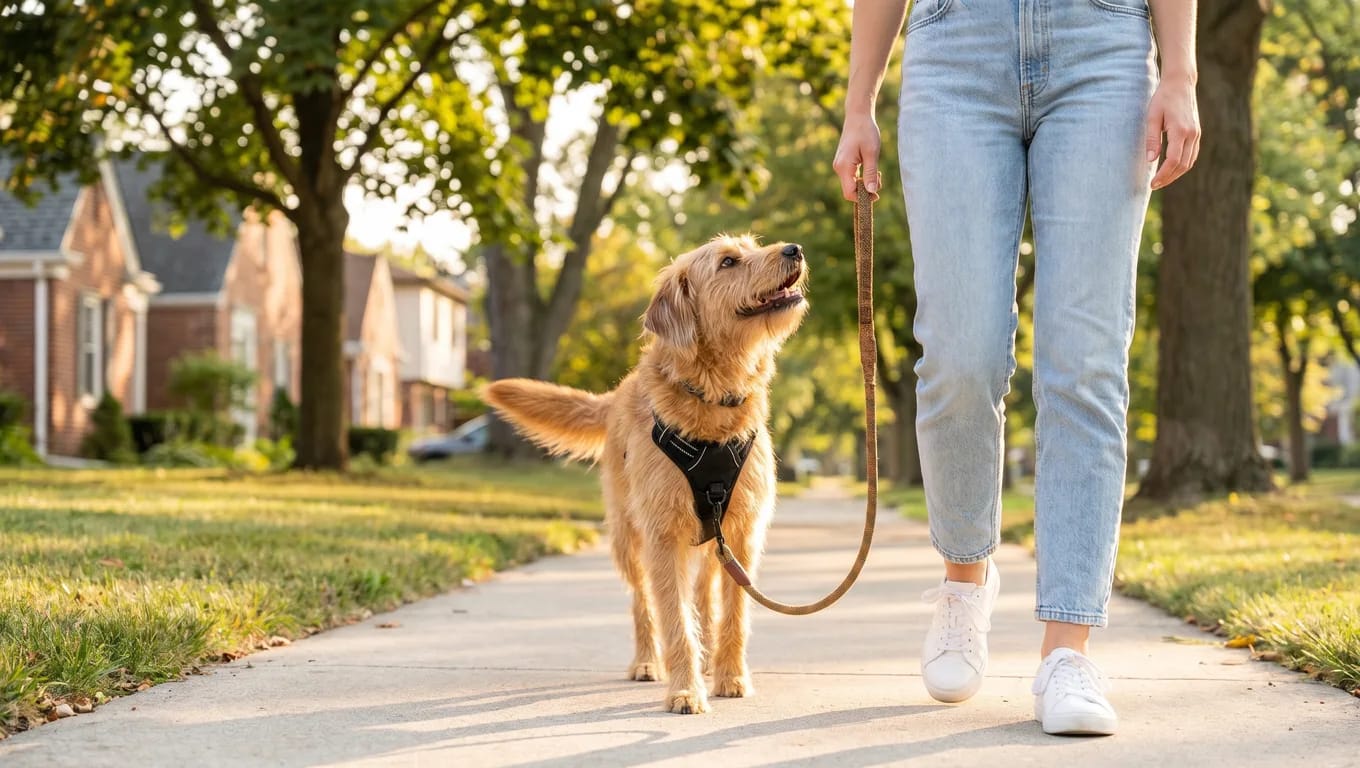
A front-clip harness is the most useful starting point for most pullers. When your dog surges forward, the front attachment turns them gently back toward you instead of letting them drive straight ahead. It buys you calmer moments to reward, without relying on pain or pressure on the neck.
Skip choke chains, prong collars, and retractable leashes while you teach loose leash walking. Aversive collars suppress pulling through discomfort rather than teaching your dog what to do instead, and they carry real risk of injury to the throat and spine. Retractable leashes reward pulling by feeding out more line every time your dog leans forward, which is the exact opposite of what you want.
Treats and a treat pouch
You will reward generously in the early stages, so use small, soft, high-value treats your dog can eat in a second without stopping to chew. A treat pouch clipped to your waist keeps both hands free and lets you reward fast, which is what makes the training stick.
How to teach loose leash walking, step by step
This is the core method. Work through the steps in order. Each one builds the muscle for the next, and skipping ahead is the most common reason people stall out.
The single rule underneath every step: a tight leash never gets your dog where they want to go. Forward motion is the reward, and it is only available when the leash is loose.
1Start indoors with zero distractions
Begin somewhere boring. Your hallway or living room is perfect because there is nothing competing for your dog's attention.
Clip on the leash, hold a treat at your side near your leg, and take a few steps. When your dog walks next to you with a loose leash, mark the moment with a word like "yes" and feed the treat at your leg. You are teaching one idea: good things happen by my side.
2Reward the position you want
Decide which side you want your dog to walk on and be consistent. Every few steps that your dog stays in that zone with slack in the leash, mark and reward.
Feed the treat low and at the seam of your trousers, not out in front of you. Where you deliver the food is where your dog will want to be, so reward in exactly the spot you want them walking.
3Become a tree when the leash goes tight
Now add the consequence for pulling, and it is the gentlest one possible: nothing happens.
The moment the leash tightens, stop walking. Plant your feet and become a tree. Do not yank the leash and do not nag. Just wait. Your dog will eventually ease the tension, glance back, or step toward you. The instant the leash softens, say "yes" and walk on. This is the heart of how to get your dog to stop pulling on the leash: pulling pauses the walk, and a loose leash restarts it.
4Add the "penalty turn"
For dogs who are very focused on a target ahead, add a turn. When the leash goes tight, calmly turn and walk in the opposite direction. Your dog now has to catch up and reorient to you.
Keep the turn smooth and unemotional, never a punishing jerk. The lesson teaches itself: drifting ahead means the destination slides further away, while hanging back with you keeps the walk moving forward.
5Raise the difficulty gradually
Once your dog is reliable indoors, move outward in small jumps:
- Your backyard or a quiet hallway in the building.
- The quiet pavement directly outside your door.
- A calm residential street at an off-peak time.
- Busier streets, parks, and places with other dogs.
Each new environment is harder, so drop your criteria when you move up a level. Reward more often at first, then thin out the treats as your dog succeeds. If your dog falls apart in a new place, you have moved up too fast. Step back to an easier setting and rebuild.
Keep early sessions short, around 5-10 minutes, and end while your dog is still succeeding. Three short, calm walks where the leash stayed loose will teach more than one long walk where it was tight the whole time.
How long does it take to stop a dog pulling?
There is no single answer, because it hinges on your dog's age, history, and how consistent you are. A young puppy with no pulling habit can pick it up in a couple of weeks. An adult dog who has hauled you down the street for three years needs longer, because you are overwriting a habit they have rehearsed thousands of times.
A realistic rough timeline for steady, daily practice:
| Stage | Roughly when | What it looks like |
|---|---|---|
| First understanding | Week 1-2 | Loose leash indoors and in quiet spots |
| Building reliability | Week 3-6 | Good walking on familiar streets |
| Real-world proofing | Month 2-4 | Holds up around mild distractions |
| Solid habit | Ongoing | Loose leash is the default, with occasional reminders |
Two things matter more than raw time:
- Consistency. If pulling pays off even some of the time, your dog will keep trying it. Everyone who walks the dog needs to follow the same plan.
- Management while you train. On days you cannot actively train, you do not have to be perfect, but try not to let your dog rehearse hard pulling. A front-clip harness and a calmer route protect your progress.
Common mistakes that keep your dog pulling
Even with the right method, a few habits quietly undo your work:
- Rewarding too late. If you mark and treat after your dog has surged ahead, you reward the surge. Catch and reward the loose leash, not the recovery from a pull.
- Letting pulling work sometimes. One walk where you let your dog drag you to the park can wipe out a week of training. Be consistent.
- Going too far, too fast. Jumping straight to a busy park before the basics are solid sets your dog up to fail.
- Nagging the leash. Constant little tugs become background noise your dog learns to ignore. Let the tree and the turn do the teaching.
- Skipping enrichment. A dog with pent-up energy pulls harder. Make sure your dog gets sniffing time, play, and mental work outside of leash training.
You can absolutely build a calm, loose leash on your own, but a few sessions with a good obedience class speed things up and give you live feedback you cannot get from an article. Use the Canlyo app to find and book an obedience or loose leash walking class near you, then track your dog's progress between sessions so the calm walks become your new normal.