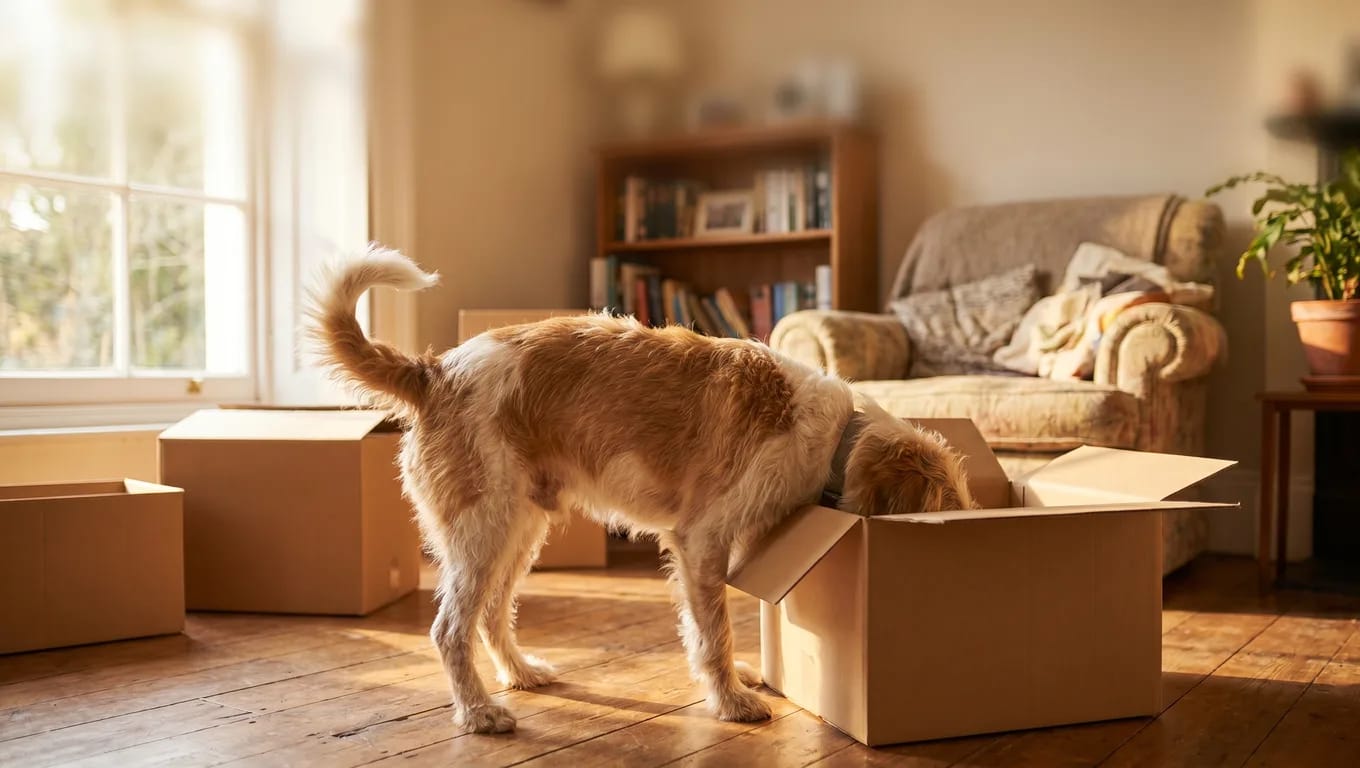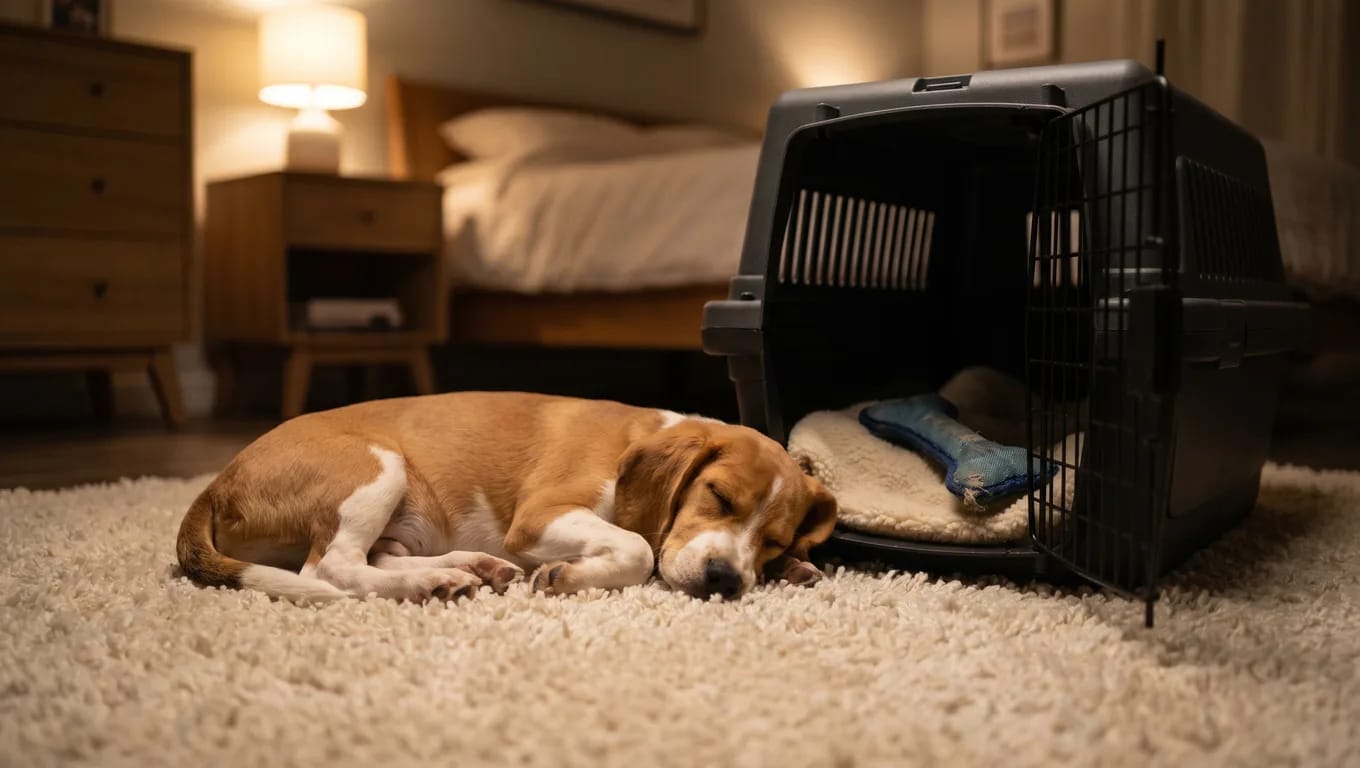
It is 2 a.m. Your new puppy is wailing from the crate beside your bed, you are slumped on the cold kitchen floor, and you are quietly convinced you have broken this dog on night one. You have not. Almost every new owner ends up here, bleary-eyed, thumbing "crate training a puppy at night" into a phone in the dark. The reassuring truth: a crate is one of the kindest, most useful things you can give a puppy, and the early-morning crying is a short, predictable phase, not a verdict on your life together.
This guide walks you through it the way a professional trainer would: a crate setup your puppy actually likes, a realistic puppy crate training schedule built around a tiny bladder and a growing brain, and a plan for surviving the first nights without teaching habits you will spend months undoing.
Why a crate is worth the effort
A crate is not a cage you shut a puppy in for some peace and quiet. Done well, it becomes the one corner of a loud new world that belongs entirely to your puppy: a small, safe den where rest is allowed. The payoff arrives quickly.
- Faster house-training. Dogs avoid soiling where they sleep, so a correctly sized crate builds bladder control sooner than a free-roaming puppy ever manages.
- Safety when you cannot watch. A puppy who cannot reach chewed cables, stairs, or your shoes stays out of trouble and out of the emergency vet.
- A portable safe space. A dog who loves the crate travels better, settles at the vet, and copes with guests and change with far less stress.
- Calmer nights. Once the rhythm clicks, the crate quietly says "we are off duty now," and you both finally sleep.
The crate is never a punishment. Send your puppy there in anger, or leave them shut in for hours, and it stops being a den and becomes a place to dread. Keep every association calm and positive.
When to start crate training a puppy
The short answer to when to start crate training a puppy is the day they come home, usually around eight weeks old. Every night your puppy spends loose on the bed or wandering the house is a night spent rehearsing a sleep habit you will later have to undo.
That said, "start" means start gently. At eight weeks you are not asking for long stretches or perfect silence. You are introducing the crate as a good place and letting your puppy form a happy first impression. The structure tightens over the following weeks, as the bladder and the attention span grow up together.
| Age | Realistic daytime crate stretch | Night-time reality |
|---|---|---|
| 8-10 weeks | 30-60 minutes | 1-2 wake-ups for the toilet |
| 10-12 weeks | 1-2 hours | Often one wake-up |
| 3-4 months | 2-3 hours | Many sleep through, some still wake |
| 4-6 months | 3-4 hours | Usually sleeping through |
| 6 months and up | Up to 4-5 hours | Sleeping through the night |
Treat these as guides, not targets to force. The bladder is the bottleneck, and pushing past it only sets your house-training back.
How to set the crate up so your puppy loves it
Get the setup right and crate training a puppy gets dramatically easier. Get it wrong and you will fight the crate for weeks.
Pick the right size
The crate should be just big enough for your puppy to stand up, turn around, and lie down comfortably, and no bigger. Too much room lets a puppy toilet in one corner and sleep in the other, which quietly defeats house-training. Bought a large crate to grow into? Use a divider to shrink the usable space, then move it back as your puppy grows.
Make it a den, not a display case
- Soft bedding they cannot easily shred, sized to fill the floor.
- A safe chew or two, so settling in comes with something to do.
- Partial cover. A blanket draped over part of the crate, leaving airflow, makes it darker and more den-like, which many puppies find soothing.
- A quiet, draft-free spot. For the first weeks, that spot is your bedroom.
Build a positive first impression
Never start by closing the door. For the first day or two, prop it open and let the crate become the place where good things happen.
- Toss treats inside and let your puppy wander in and out freely.
- Feed meals just inside, then fully inside, so dinner happens in the crate.
- Drop a stuffed chew in there so your puppy chooses to go in alone.
- Once they settle willingly, close the door for a few seconds while they chew, then open it before any fuss starts. Build up slowly.
The goal of week one is simple: your puppy walks into the crate on their own because good things happen there. Nail that, and night-time gets far easier.
A realistic puppy crate training schedule
A puppy thrives on rhythm, and a clear puppy crate training schedule is what turns chaos into something predictable. One rule sits underneath it all: a puppy needs a huge amount of sleep, often 16-18 hours a day, and an overtired puppy turns frantic, bitey, and impossible to settle. Crate naps are not optional extras; they are how your puppy regulates.
A workable daytime rhythm for a young puppy repeats the same loop on a roughly two-hour cycle:
| Time | Activity |
|---|---|
| 7:00 | Wake, straight outside to toilet |
| 7:15 | Breakfast in the crate, then short play and training |
| 8:30 | Toilet, then crate nap |
| 10:30 | Wake, toilet, play, sniff, explore, then a nap |
| 13:00 | Lunch, gentle activity, then a nap |
| 16:00 | Wake, toilet, play and training, then a nap |
| 18:30 | Dinner, toilet, family time |
| 20:00 | Calm wind-down, last big toilet trip |
| 22:00 | Final toilet, then bed in the crate |
The pattern that matters more than the exact clock is toilet, activity, toilet, crate nap, repeat. Take your puppy out the moment they wake, after eating, after play, and before crating. Catching those trips is what makes the crate a house-training tool rather than a place your puppy holds on too long.
Never crate a young puppy for longer than they can comfortably hold their bladder. A rough rule is one hour per month of age plus one, up to a maximum of around four hours in the daytime, even for an adult. Long, lonely stretches cause genuine distress and can undo your progress.
Crate training a puppy at night: surviving the first nights
This is the part everyone dreads, and what most people searching crate training puppy at night are really after. Here is how to get through it with your sanity, and your puppy's trust, both intact.
Keep the crate in your bedroom
For the first few weeks, put the crate right beside your bed. Your puppy has just left the warmth and noise of the litter, and total isolation on night one is genuinely frightening. Being able to hear and smell you is what lets a young puppy settle. Move the crate toward its permanent spot gradually, once nights are reliably calm.
Set the night up for success
- Tire the brain, not just the body. A short sniffing or training session settles a puppy better than wild play, which usually backfires into the overtired zone.
- Final toilet trip last thing. Take your puppy out right before bed, calmly, with no play, so the only reason to wake you is a real need.
- Warmth and comfort. A snug bed, partial cover, and a soft toy or something that smells of home all help.
- A boring night. Dim lights, quiet, no eye contact or chatter once it is bedtime.
Plan for the night-time toilet trip
An eight-week-old puppy almost certainly cannot last the whole night, so expect to get up once, sometimes twice, in the early weeks. When your puppy wakes, read the situation before you react. If it has been a few hours and this is likely a real need, take them out calmly and silently: no talking, no play, no treats. Outside, toilet, straight back to the crate. You are answering a need, not starting a party. If they settled an hour ago and have already been out, this is more likely a settling protest than a full bladder.
Handle the crying without creating a habit
This is the knife-edge that worries everyone. Rush in and reward every whimper, and you teach your puppy that crying summons you. Ignore genuine distress, and you erode the trust the crate depends on. The middle path:
- Learn the difference. A toilet cry tends to be insistent and escalating. A settling grumble usually rises, then fades as your puppy resettles.
- Give a settling grumble a moment to fade before you react, rather than leaping up at the first sound.
- Never let real distress run on. Frantic, panicked crying that keeps building is not something to "let cry out." Reassure calmly, check for a toilet need, and ask whether the steps got rushed.
- Stay boring, so nothing about the night is worth repeating.
Most puppies move from several wake-ups to sleeping through within a few weeks, with the bladder catching up around 3-4 months. Consistency is what shortens that window.
If your puppy seems truly panicked when alone, repeatedly soils a correctly sized crate, or the distress is not easing after a couple of weeks of calm, consistent work, step back. Forcing it can create a lasting fear of the crate. A few days of slower reintroduction, or advice from a qualified trainer, usually turns it around.
What to do when crate training stalls
If nights are not improving, it is almost always one of these, rather than a stubborn puppy or a failed method:
- The crate is too big. Add a divider so there is no room to toilet away from the sleeping spot.
- Too much energy at bedtime. Build in a calm wind-down, with enough daytime sniffing, chewing, and gentle exercise.
- Too many daytime hours crated. A puppy shut in all day will not settle all night either. Balance crate time with company and activity.
- Going too fast. If you were shutting the door for long stretches before your puppy was happy with it open, drop back several steps and rebuild.
Turn the first weeks into a confident start
Crate training rarely fails because an owner is doing the wrong thing. It stalls because the early weeks are exhausting and lonely, and because it is genuinely hard to know whether that 2 a.m. cry means "I need the toilet" or "I just want company." A good puppy class gives you a trainer to ask, a routine to lean on, and the reassurance that what you are seeing is normal, all during the short window when these foundations matter most.
Want expert eyes on those first weeks? Find and book a puppy class near you on Canlyo, and build crate training, house-training, and confidence with a trainer beside you.
Hang in there. The broken sleep feels endless while you are in it, but it is one of the shortest phases of dog ownership. Stay calm, stay consistent, and within a few weeks the howling fades into a puppy who trots into the crate, curls up, and sleeps the night through, in a den they genuinely love.