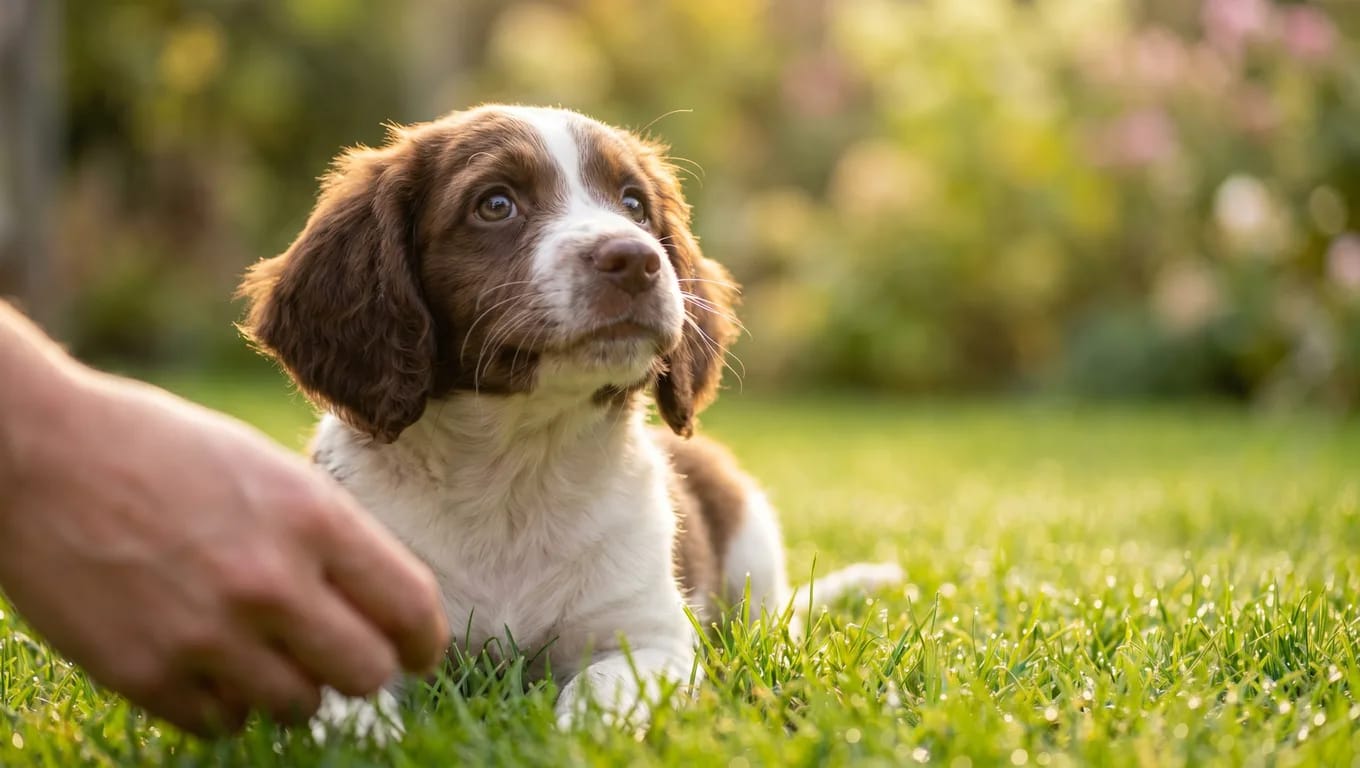
It's the middle of the night, your puppy has been crying in his crate for ten minutes, and you're sitting on the hallway floor wondering if you're getting all of this wrong. Take a breath: you're not. Those first few weeks with a new puppy at home are exhausting and a little chaotic, and almost nobody warns you just how intense they're going to be. The good news is that knowing how to train a puppy during this stretch comes down, mostly, to a handful of simple things done well and repeated calmly. In this guide we'll walk through it step by step: how to build a routine, get a head start on potty training, make the most of the socialization window, and lay down gentle foundations that will last your dog's whole life.
What to Expect in the First Few Weeks
Before you train anything, it helps to understand what a brand-new puppy is going through. He's just been separated from his mom and littermates, moved to a new home, and dropped into a world of unfamiliar smells and sounds where everything is new. He's learning every single second, whether you mean for him to or not. That has two implications that change how you approach training a puppy from day one:
- Everything that happens teaches him something. There's no such thing as "I'm not training yet." Every time you respond to his crying, every spot you let him pee in, every person he meets, it's all learning. Puppy training starts the moment he walks through the door.
- Sleep runs the show. An eight-week-old puppy needs somewhere between sixteen and twenty hours of sleep a day. Most of the trouble you see in the early days (frantic nipping, crying, an inability to "behave") is really just being overtired.
Rushing is the enemy. You don't need your puppy to sit, shake, and walk on a leash in week one. You need him to feel safe, to learn where to go potty, and to rest. Everything else falls into place once the foundation is there.
How to Build a Routine That Helps Him Feel Safe
Puppies, like young kids, settle down when the world is predictable. A simple routine tells him "I know what comes next," and that cuts down on crying, accidents, and anxiety far more than any clever trick ever will. You don't need a military schedule timed to the minute, just a steady order to the day:
- First thing after waking up: head outside, or to the potty spot, right away.
- After eating, drinking, playing, or napping: another potty break (these are the highest-risk moments for an accident).
- Meals on a set schedule, usually three or four a day at this age, which also makes it predictable when he'll need to go.
- Short bursts of play and training, always followed by a quiet nap.
- A consistent place to sleep, whether that's a crate or a bed in a calm corner, where nobody bothers him.
The first few weeks are also the time to gently introduce everyday things: the collar and leash worn for a bit around the house, the brush, having his paws and ears handled, the sound of the vacuum from a distance. Pair every new thing with something good (a treat, a happy voice) and never force it.
For a few days, jot down when your puppy eats, drinks, sleeps, and goes potty. In under a week you'll see a clear pattern emerge, and you'll be able to get ahead of potty breaks before any accidents happen.
Potty Training: The Basics That Actually Work
Potty training (teaching him to go outside) is priority number one in the first few weeks, and it's simpler than it sounds once you get the logic: a young puppy can't hold it for long, so the trick isn't to make him "hold it" but to get him to the right spot before he needs to go, and to reward him like he just won the lottery when he gets it right.
1Take Him Out Constantly, Always at the Key Moments
Take your puppy to his potty spot after waking up, after every meal, after drinking, after playing, and, in general, every hour or two. As a rough rule of thumb, puppies can usually hold it about one hour per month of age plus one extra hour (a two-month-old, around three hours; a three-month-old, around four). Don't wait for the signs: by the time he's circling and sniffing the floor, it's often already too late.
2Reward On the Spot, at the Exact Moment
The instant he finishes going in the right place, reward him right there with a happy voice and a small treat. The reward has to land immediately, not once he's back inside, or he'll learn that the good thing is "coming indoors" rather than "going potty outside." If you like, you can pair a soft cue word ("go potty") while he goes, and over time he'll come to recognize it as a signal.
3Handle Accidents Without Making a Scene
There will be accidents. They're a normal part of the process, not a failure on your part or your puppy's.
- If you catch him in the act, interrupt with a soft sound and carry him to his spot to finish there, then reward him.
- If you find it after the fact, just clean it up. Scolding does nothing: he won't connect your frustration with something he did a while ago.
- Clean with an enzymatic cleaner, not bleach or ammonia. If any urine smell lingers, he'll head right back to the same spot.
Never punish a puppy for an accident, rub his nose in it, or yell at him. All he learns is to be afraid of you and to hide when he goes potty, which makes potty training a whole lot harder. Supervision and anticipation work; punishment doesn't.
4Limit His Space When You Can't Watch Him
A puppy loose in the whole house with no supervision is going to have accidents. When you can't keep an eye on him, use a crate, a playpen, or a small room. Dogs tend not to soil where they sleep, so a confined space helps him hold it and helps you get him outside in time.
The Socialization Window: The Stage That Never Comes Back
If you take only one idea away from this guide, make it this one. Between 3 and 14 weeks of age (loosely up to 16) puppies go through the socialization period: a window when their brain is especially primed to accept whatever they encounter as "normal." Whatever your puppy experiences pleasantly during these weeks will shape his adult temperament. Whatever he doesn't encounter will be much harder for him to accept later on.
That's why puppy socialization isn't an optional extra; it's the highest-return investment you'll make in his upbringing. And socializing doesn't just mean playing with other dogs. It means exposing him, positively and without overwhelming him, to the widest possible variety of:
- People: of different ages, with beards, with glasses, in hats, in wheelchairs, calm children.
- Other dogs and animals that are healthy, vaccinated, and well-balanced.
- Surfaces and environments: grass, gravel, shiny floors, stairs, the car, the city.
- Sounds: traffic, appliances, rain, fireworks at low volume, doorbells.
- Handling: having his paws, ears, and mouth touched, mimicking a vet exam.
The key is positive and at his own pace. Every new experience should end on a good note (with treats, play, or calm), never with the puppy scared and overwhelmed. A bad experience at this stage can leave a mark; always let him approach on his own and reward him for being curious.
Here's where a very real concern comes up: vaccinations. The socialization period overlaps with the vaccination schedule, which is why a lot of owners keep their puppy shut in until he's fully protected, and miss the window entirely. Talk to your vet about how to socialize safely in the meantime: carrying him down the street in your arms, introducing him to healthy, vaccinated adult dogs, or signing up for puppy classes that require vaccinations to be current. The risk of an under-socialized puppy is usually greater than the risk of careful exposure.
How to Train a Puppy: First Gentle Behaviors
With the routine, potty training, and socialization underway, you can start teaching him specific behaviors. Knowing how to train a puppy at this age is, above all, about keeping it easy, short, and fun. Always use positive reinforcement: reward what you want to see more of, and ignore or redirect what you don't.
| Skill | Why Start Early | How to Approach It |
|---|---|---|
| His name | It's the foundation of all communication | Say it and, when he looks at you, reward |
| Coming when called | It can save his life as an adult | Call him cheerfully and reward every time he comes |
| Tolerating the crate | Prevents anxiety and helps with potty training | Toss treats inside, let him go in on his own |
| Being left alone for a bit | Heads off separation anxiety | Very short absences that you gradually extend |
| Sitting | A simple way to ask for things calmly | Lure him with a treat over his head |
Three principles that apply to everything you teach him:
- Keep sessions very short. Two or three minutes a few times a day beat half an hour straight. Always end on an easy win.
- Reward at the exact second he gets it right. Reward late, and you teach him something else entirely.
- Redirect, don't punish. If he nips your hands or jumps up, offer an alternative (a chew toy, a sit) instead of scolding. As for the nipping, that busy little mouth is normal at this age, and you work through it by redirecting it onto toys.
Common Mistakes in the First Few Weeks
When something isn't going well, it's usually down to one of these and not a "difficult" puppy:
- Expecting too much, too soon. He's a baby: he can't hold his bladder for hours or focus for long.
- Skipping naps. A puppy who doesn't rest turns frantic and nippy, and looks like he's behaving terribly when he's really just sleepy.
- Punishing fear or accidents, which damages trust and makes worse the very thing you were trying to fix.
- Staying home "until he's fully vaccinated" and missing the socialization window.
- Everyone in the house doing something different. If one person lets him up on the couch and another doesn't, the puppy can't learn the rule. Get on the same page.
When to Sign Up for a Puppy Class
You can start everything in this guide at home today, but a good puppy class speeds up the process and takes the pressure off you. It lands right in the socialization window: your puppy plays and learns his limits with others his own age, meets new people and environments in a safe setting, and you get guidance from a professional who fine-tunes your handling, dials in your reward timing, and answers questions before they turn into problems. If intense fears show up, nipping that won't let up, or any behavior that worries you, a qualified trainer is the best investment you can make, and the sooner the better.
Want to start off on the right foot and make the most of these first few weeks? You can find and book a puppy class with a qualified trainer near you on Canlyo, and give your puppy the best possible foundation right when it matters most.
These first few weeks feel endless while you're in them, between short nights and puddles in the hallway, but they pass in the blink of an eye. Calm, routine, and a handful of good experiences are worth more right now than any perfect cue. Lay that foundation patiently: the balanced, good-natured adult dog waiting for you on the other side is well worth every early morning.