You take your dog out for a walk down the same old sidewalk and, while you're running through your grocery list, he stops at a lamppost and stands there reading it like it's the morning paper. Who came by, when, what they ate, whether they were healthy or on edge. That pause you write off as a waste of time is, to him, a flood of information you can't even sense. A dog's sense of smell is, no exaggeration, one of the most astonishing sensory machines in the animal kingdom, and understanding how it works completely changes the way you see your companion. In this guide we break down how a dog's sense of smell works, why it's so powerful, which breeds have the best noses, and how you can start putting it to use at home.
How a Dog's Sense of Smell Works
A dog's sense of smell isn't just "ours but better." It's a different system, built on a whole other scale and with parts we simply don't have. To get it, it helps to follow a scent on its journey from the moment it enters the nose to the moment it reaches the brain.
A Nose Built to Smell, Not to Breathe
The first surprise is that a dog separates breathing from sniffing. When he inhales normally, the air heads straight back to the lungs. But when he sniffs, with those short, rapid bursts we all know, the airflow gets diverted to a specialized area at the top of the nose, where the cells responsible for detecting odors are packed in. Smelling and breathing are, for the most part, two separate jobs.
There's more fine engineering at work:
- The nostrils move independently. Each one can draw in air on its own, which helps the dog figure out which direction a scent is coming from, the same way two ears help us pinpoint a sound.
- Air exits through the side slits. When a dog exhales, the air escapes out the sides of the nose instead of straight ahead. That way it doesn't blow away the scent he's working, and it actually pulls fresh air back in. It's why a dog can sniff almost nonstop.
- The wet nose helps. That cool, damp nose traps odor molecules from the air and holds them long enough to analyze.
Millions of Receptors Firing at Once
This is where the real muscle of the system lives. The inside of a dog's nose is lined with the olfactory epithelium, a huge folded surface loaded with receptors. While a person has around six million scent receptors, a dog can have anywhere from two hundred to three hundred million, depending on the breed. This isn't a ten or twenty percent upgrade. We're talking about an entirely different order of magnitude.
Each receptor is tuned to recognize specific molecules. When a scent comes in, thousands of them fire at once in a unique pattern, like the keys of a giant piano pressed together to form a chord that's one of a kind. Every smell has its own.
The Organ That Detects What It Can't Even Smell
Dogs also have a part we get almost no use out of: the vomeronasal organ (also called Jacobson's organ), a detector sitting on the floor of the nasal cavity. Its job isn't to pick up ordinary odors but to read pheromones, those chemical signals animals use to communicate reproductive status, identity, or mood.
That's why you'll sometimes see your dog freeze up, mouth slightly open and a strange look on his face, after sniffing another dog or a spot on the ground. Nothing's wrong with him. He's channeling those molecules toward the vomeronasal organ to "read" a social message you'd never have known was there.
A Brain Wired for Scent
All those antennas would be useless if the brain didn't know what to do with the signal. And here dogs win in a landslide again. The part of the brain devoted to analyzing smells, the olfactory bulb, is proportionally about forty times larger than ours. In practice, that means smell isn't just another sense for your dog. It's his primary way of understanding the world. Where we see a scene, he smells a story with layers, dates, and characters.
A Dog's Sense of Smell vs. Ours: A Comparison That Hits Hard
When you put all the pieces together (more receptors, a nose that separates smelling from breathing, an extra organ for pheromones, and a brain built around scent), you start to see why comparing a dog's sense of smell to ours feels almost unfair.
| Feature | Human | Dog |
|---|---|---|
| Scent receptors | ~6 million | 200-300 million |
| Olfactory bulb (relative size) | Baseline | ~40 times larger |
| Functional vomeronasal organ | Barely | Yes, very active |
| Independent nostrils | No | Yes |
To put an easy number on it: depending on the case, a dog's sense of smell is estimated to be somewhere between ten thousand and one hundred thousand times more sensitive than a person's. That's hard to picture, so here's a classic comparison: if we can taste a spoonful of sugar in our coffee, a dog could detect that same spoonful diluted in two Olympic swimming pools of water. And it's not just minute amounts he picks up. He separates smells into layers. In a stew, you smell "stew." Your dog smells the beef, the carrot, the bay leaf, and the onion all on their own.
That sensitivity is why dogs handle jobs no machine has matched yet: detecting drugs and explosives, search and rescue, tracking wildlife for conservation projects, and even medical alerts like blood sugar crashes or certain types of cancer. The same nose that reads the neighbor's lamppost saves lives every day.
Dogs With the Best Sense of Smell: The Reigning Champions of the Nose
Every dog smells far better than we do, but they don't all play in the same league. Some breeds have been bred for centuries to follow a trail, and it shows on two fronts. On one hand, in the anatomy: more receptors, a longer muzzle, and ears that help stir scent up toward the nose. On the other, in temperament, which is what really sets them apart: the focus and the sheer stubbornness to keep working a trail until they reach the source.
Bloodhound
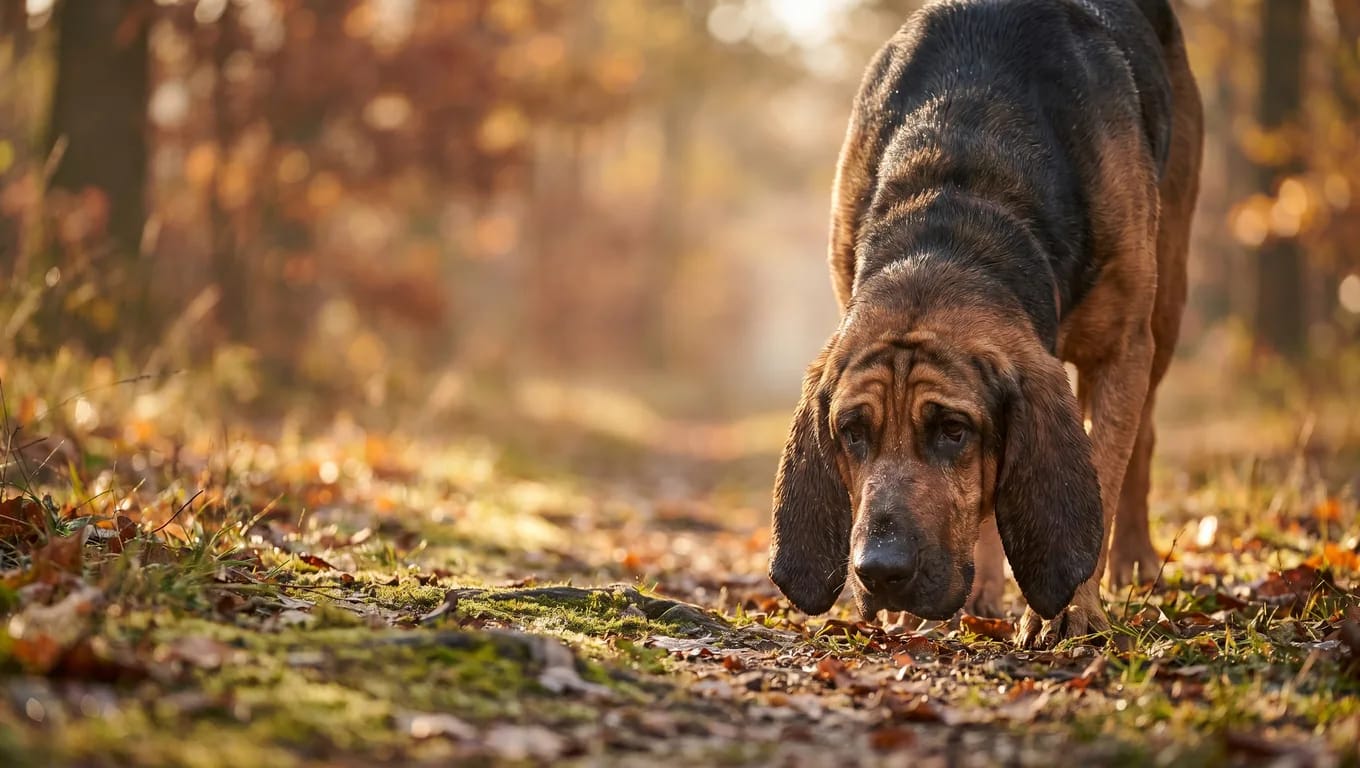
The undisputed king. With close to three hundred million receptors, his long ears and loose skin lift and trap odor molecules off the ground and funnel them toward the nose. A Bloodhound's trail is so reliable that in many countries it's admissible as evidence in court.
Basset Hound
Built low to the ground, the Basset works a trail almost grazing the dirt, right where scent settles and pools. His ears and the loose folds under his chin do the same job of stirring scent up toward the nose.
Beagle
Small, tireless, and blessed with an extraordinary nose, the Beagle is the go-to for detection teams in airports around the world. His manageable size and his enthusiasm for food also make him a star of nose work at home.
German Shepherd and Belgian Malinois
They aren't classic scent hounds, but they pair an excellent nose with a work ethic and a desire to please that make them irreplaceable in police, military, and rescue work. About as versatile as it gets.
Springer Spaniel and Other Gun Dogs
Bred to find and flush game, Spaniels and Pointers combine a great nose with stamina and a willingness to cooperate, which is why they also shine in detection.
If your dog isn't on this list, it doesn't mean his nose is "weak." Even flat-faced breeds, which breathe with more effort, smell infinitely better than any person. The difference between breeds is real, but it's tiny next to the gulf separating any dog from us. Your shelter mutt comes with the same elite gear, standard.
Why You Should Let Your Dog Sniff More
Understanding a dog's sense of smell has one very direct practical takeaway: if the nose is his dominant sense, cutting off his access to the world of scent is like sending a person out for a walk blindfolded.
Letting your dog sniff at his own pace during walks (what some trainers call "sniffaris" or decompression walks) has measurable benefits:
- It genuinely tires him out. Processing scent is intense mental work. Ten minutes of focused sniffing wears a dog out more than half an hour of running.
- It calms him down. Dropping the head and tracking is a behavior that lowers stress. It's hard to be anxious and sniff with real interest at the same time.
- It builds independence and confidence. When a dog gets to decide what to investigate, he gains self-assurance, which is especially valuable for shy or reactive dogs.
Trading some of the "come on, let's go" for "take your time" is one of the simplest and cheapest gifts you can give him.
From Sniffing by Accident to Sniffing With a Purpose: Scent Work
Once you see your dog as the scent expert he is, the natural question follows: what if we gave him something specific to find? That's where scent work, or nose work, comes in, an activity that turns that instinct into a game with rules.
The idea is beautiful precisely because it's so accessible: you start by hiding treats for your dog to find with his nose and, little by little, you teach him to search for a target odor and tell you when he's pinpointed it. You don't need expensive gear or an athletic dog. Any breed, any age, and a handful of treats will do.
If you want to go from theory to practice, we have a complete step-by-step guide in our article on scent work for dogs. But you can take the first step today: hide three or four smelly treats around the living room, say "find it" with a little excitement, and watch him light up.
When the "find it" game starts to feel too easy, a scent work class takes your dog to the next level: official target odors, clean alerts, and searches in new environments guided by a pro. You can find and book a nose work class near you on Canlyo and give that extraordinary nose the challenge it deserves.
The next time your dog gets glued to a lamppost, remember what he's got between his nostrils: hundreds of millions of receptors, an organ dedicated solely to reading chemical messages, and a brain built around scent. He isn't wasting time. He's doing the one thing he's best at in the entire world. And now that you know how it works, you can help him do it even better.