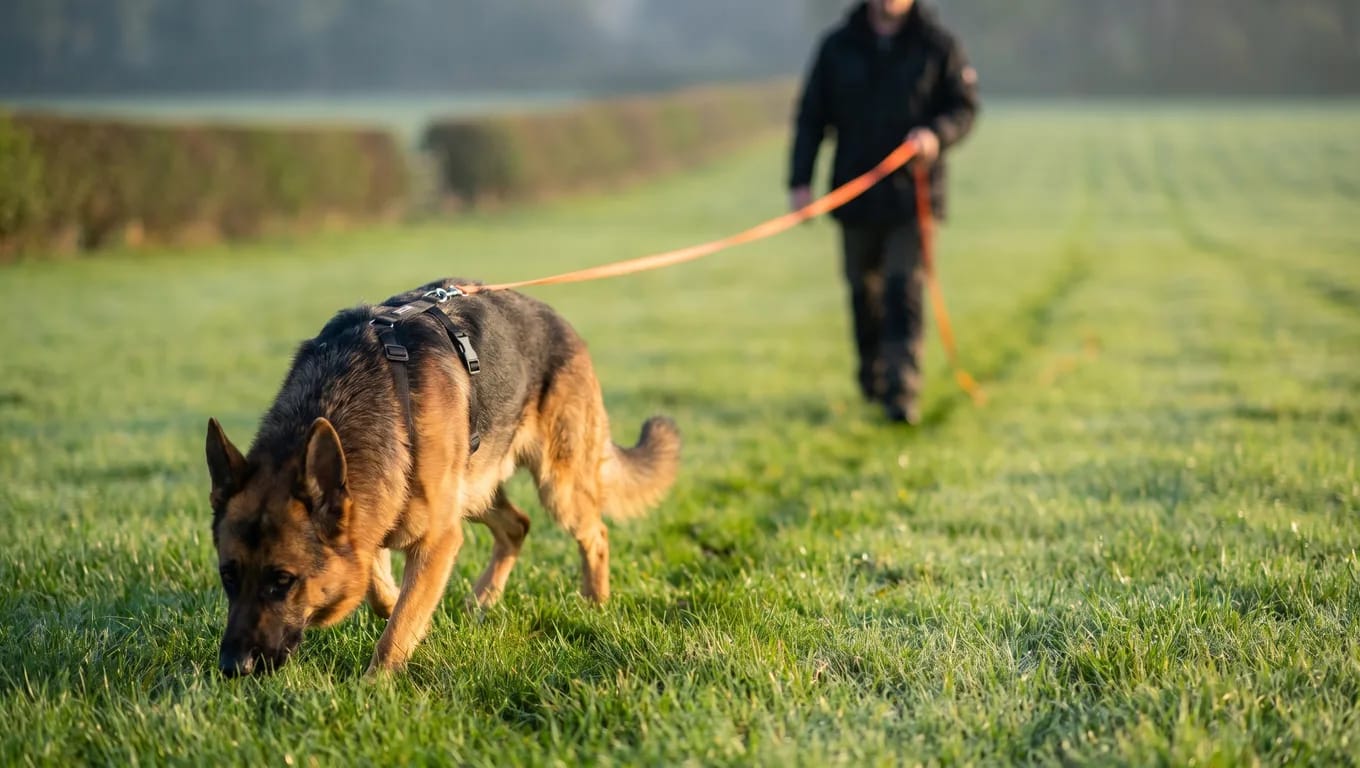
A volunteer slips behind a row of parked cars, walks a winding path across a wet field, doubles back along a hedge, and ducks out of sight into a barn. Five minutes later your dog sniffs a worn glove, drops its nose, and pulls you straight down that exact route, past three other people who crossed the same grass, to the one person whose scent was on the glove. No commands about left or right. No treats dropped in the path. Just a dog reading a story written in skin cells and sweat that you cannot even detect. That, in a single run, is mantrailing.
If you have been wondering what is mantrailing and whether it might suit your dog, this guide walks you through what the sport actually is, how a mantrailing dog finds a person, how the activity differs from tracking and nose work, and exactly what a first session looks like.
What is mantrailing?
Mantrailing is a scent sport in which a dog follows the unique scent of a specific missing person and finds them. The dog is given a scent article, an item that carries that one person's smell, such as a glove, a sock, or a worn T-shirt, and is then asked to discriminate that individual from every other scent in the environment and follow their trail to its source.
The sport grew directly out of real-world search and rescue work. Trailing dogs are used by emergency teams to locate lost hikers, missing children, and people with dementia who have wandered from home. The recreational version keeps the same core skill, scent discrimination, but turns it into a structured, reward-based game that pet dogs and their owners can enjoy together at a club or in a class.
What makes mantrailing special is that you, the handler, are largely a passenger. Your job is to read your dog, manage the long line, and trust the nose. The dog leads. For many owners, that shift from directing the dog to following it is the most surprising and rewarding part of the sport.
Why dogs are so good at this
It helps to remember what your dog's nose is working with. A dog has up to three hundred million scent receptors, against roughly six million in a human, and a far larger share of its brain devoted to smell. Every person constantly sheds tiny skin cells, called rafts, that carry a scent signature as individual as a fingerprint. Your dog does not just smell "a human." It smells that human, and it can pick that thread out of a crowded, windblown environment.
How does a mantrailing dog actually follow a person?
A mantrailing dog is not following footprints, and it is not following a single magic molecule. It is following a scent cone, the drifting, pooling cloud of human scent that a person leaves behind as they move.
Here is roughly what happens in your dog's nose and head during a trail:
- Scent capture. At the start, your dog takes a deep, deliberate sniff of the scent article. This tells the dog which individual to look for.
- Discrimination. The dog compares that target scent against everything else in the air and on the ground, filtering out other people, animals, and distractions.
- Following the trail. The dog works the scent wherever it has settled. Scent sinks into long grass, clings to walls, pools in dips and doorways, and gets pushed around by wind, so a trail is rarely a straight line.
- Negative indication. A trained dog will also tell you when the scent is not there, by losing interest or casting around, which helps you avoid wrong turns.
- The find and the reward. When the dog reaches the person, it gets its reward, often a favorite toy or a jackpot of food, delivered by the missing person. That final payoff is what powers the entire trail.
Crucially, the dog chooses the route. Wind might have carried the scent ten meters to one side, so a good trailing dog often works alongside the actual path rather than on top of it. Watching your dog problem-solve a tricky corner, lose the scent, and methodically find it again is genuinely thrilling.
Mantrailing is one of the most inclusive dog sports there is. Age, breed, and fitness barely matter, because every dog already has the equipment and the instinct. Nervous and reactive dogs often thrive, since the dog works at its own pace, on its own terms, and is never asked to perform for an audience or interact with other dogs.
Mantrailing vs tracking vs nose work: what is the difference?
People often lump these scent activities together, but they ask the dog for quite different jobs. If you have read about scent work or tracking and are confused about where mantrailing fits, this comparison should make it click.
| Activity | What the dog finds | What scent it uses | Where it happens |
|---|---|---|---|
| Mantrailing | A specific person | One named individual's scent, from an article | Any real-world terrain: streets, woods, car parks |
| Tracking | A trail (and often articles on it) | Disturbed ground and crushed vegetation along the exact path | Usually open fields and natural terrain |
| Nose work / scent work | A hidden target odor or food | A trained substance (such as an essential oil) or food, not a person | Boxes, rooms, vehicles, and other set search areas |
In plainer terms:
- Tracking training for a dog asks it to follow the precise physical path a person walked, nose down, step by step, reading the crushed grass and churned earth. Competitive tracking is judged on staying tight to that footstep trail.
- Scent tracking for a dog in the nose work sense is about finding a thing, a hidden odor or food, and indicating it. No specific person is involved, and any handler can lay the hide. We cover this in our separate scent work guide.
- Mantrailing is about finding a person. The dog discriminates one individual from all others and follows their drifting scent however it has spread, which makes it the most "real life" of the three.
A simple way to remember it: tracking follows the path, nose work finds the odor, and mantrailing finds the person.
What does a mantrailing session look like?
Most people are surprised by how calm and methodical a first class feels. There is no chaos and no pressure. Here is the typical shape of a beginner session at a club.
The kit you will use
Mantrailing needs very little gear, and a good class usually provides most of it to start:
- A well-fitted harness. The dog works on a harness, not a collar, so it can pull into the trail freely and comfortably.
- A long line. Usually around five to ten meters, giving the dog room to work while you stay connected.
- Scent articles. Gloves, socks, or cloths carrying the target person's scent, often stored in clean bags.
- High-value rewards. Whatever your dog loves most, brought along by the person being found.
How a beginner run unfolds
Step 1: Laying the trail
A volunteer, often called the trail layer or "missing person," walks a short, simple route, perhaps twenty to fifty meters for a first attempt, and waits at the end with your dog's reward.
Step 2: Presenting the scent
You bring your dog to the start, offer the scent article, and give a cue such as "find" or "search." This is the moment the dog locks onto the target individual.
Step 3: Working the trail
Your dog drops its nose and sets off, and you follow, feeding out the long line and reading its body language. A good instructor walks with you, helping you spot when your dog is "in scent" and when it has lost it.
Step 4: The find and the party
When your dog reaches the missing person, they immediately deliver the reward and make a huge, happy fuss. As far as the dog is concerned, this celebration is the entire point, and it is what leaves the dog desperate to do it all again.
Early trails are deliberately short and easy so the dog succeeds and builds confidence. Over weeks, sessions add distance, age (older trails are harder), turns, surface changes, and "decoy" people who crossed the path, until your dog can solve genuinely complex problems.
A first session is mostly about your dog learning that the game is fun and that its nose is allowed to lead. Keep your expectations light. The win is a confident find and a wagging tail, not a perfect, textbook trail.
How do I get started with mantrailing?
You do not need any special background, and your dog does not need to be obedient, athletic, or young. You do, however, want to learn alongside someone experienced, because handling skills and trail-laying make a real difference, and bad habits are easy to build alone.
Start with a class or club
By far the best entry point is a beginner mantrailing class. A qualified instructor lays safe trails, teaches you to read your dog, manages the long line with you, and scales the difficulty so your dog keeps succeeding. You also get access to willing trail layers and decoys, which are hard to organize on your own.
Set your dog up to enjoy it
A few principles make those first weeks go smoothly:
- Use a harness, never a collar, for the trail. The dog needs to pull into the scent without discomfort.
- Bring rewards your dog truly loves. Mantrailing runs on motivation, so a high-value payoff matters more than obedience.
- Keep early trails short and successful. Confidence is built on finds, not on difficulty.
- Let the dog be wrong sometimes. Casting about and self-correcting is the dog learning, not failing.
- Stop while it is still fun. A few good trails beat one long, tiring session.
What to expect over time
Progress is steady rather than instant. In the first few sessions your dog learns the game and the cue, and over the following weeks you add trail length, aged trails, turns, urban surfaces, and distractions. Many dogs that struggle with reactivity or nerves become noticeably calmer as they discover a job they are brilliant at.
Mantrailing rewards curiosity over control, and it asks you to trust your dog in a way few other activities do. Once you have watched your own dog untangle a windblown trail and pull you to the right person, ignoring every distraction along the way, it is hard not to be hooked.
Ready to see your dog read the world through its nose? Find and book a beginner mantrailing class near you on Canlyo, and let your dog discover the job it was built for.