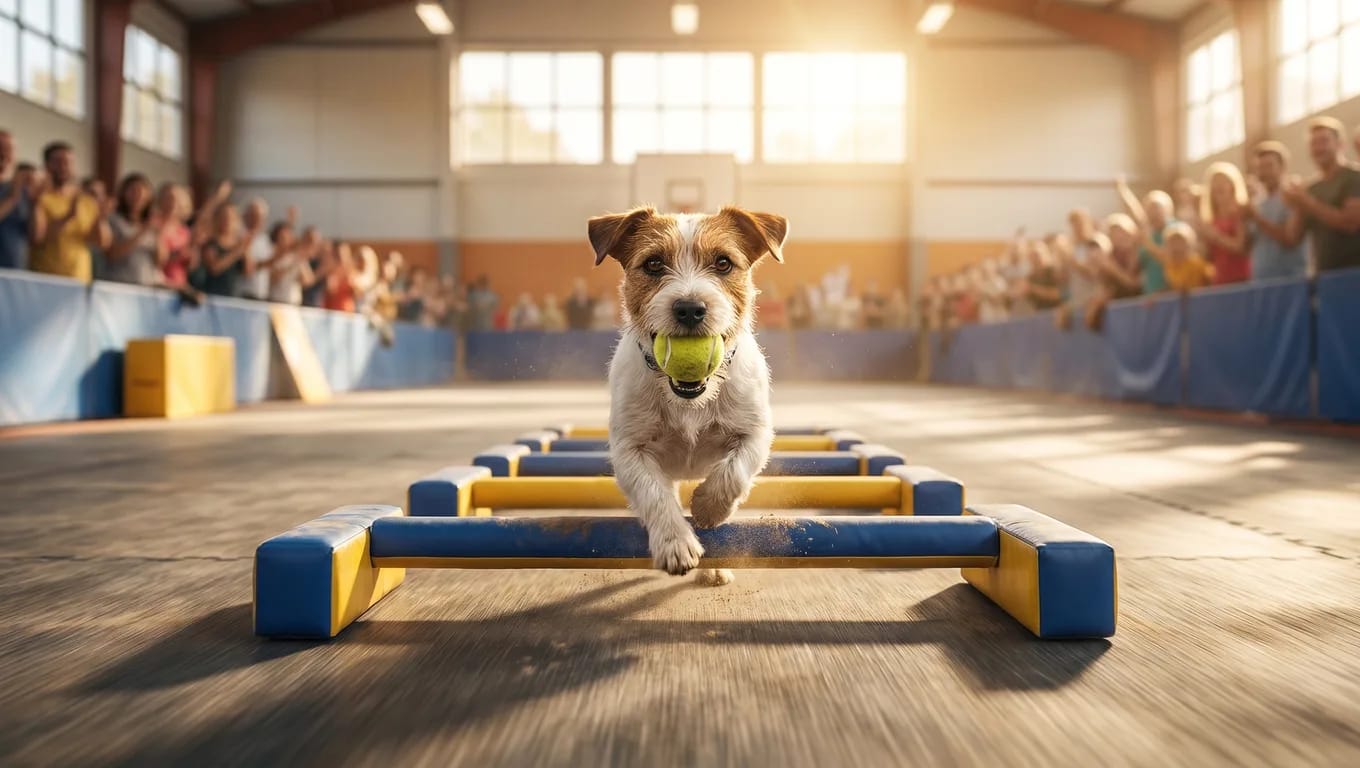
Stand near a flyball ring for thirty seconds and your heart rate climbs with the dogs'. Two lanes, two teams, and on the start signal a dog explodes off the line, clears four low jumps in a blur, slams into a spring-loaded box that fires a tennis ball into its mouth, then spins and sprints the whole way back so the next dog can launch. The noise is something else: handlers shouting, balls thudding, a happy chaos of barking. It looks like beautiful pandemonium. Underneath it is a precise relay built on timing, drive, and teamwork.
If you have ever watched a clip and wondered what all the screaming was about, this guide is for you. We will walk through exactly what is flyball, how a race works, the equipment that makes it tick, the core flyball rules, and how you get your own dog started in this gloriously loud sport.
What is flyball?
Flyball is a relay race for dogs. A team of four dogs runs one at a time, in sequence, down a straight lane of jumps to a box at the far end. Each dog jumps the four hurdles, triggers the flyball box to release a tennis ball, catches it, and races back over the same four jumps. The instant one dog crosses the start line on its way home, the next dog is released. First team to run all four dogs clean wins the heat.
That is the whole sport in one sentence, and yet people spend years chasing a faster, cleaner version of it. As a flyball dog sport, it sits at the high-energy, team end of the dog-sport world. Where agility is one dog and one handler weaving a course, flyball is a small squad working a single repeated job at full speed, against a clock and against the lane right next to them.
It grew up in California in the late 1970s, then was organized into a proper competitive sport by bodies like the North American Flyball Association (NAFA) and, in Europe and beyond, groups such as the British Flyball Association. Those organizations turned a fun backyard relay into a structured sport with sanctioned tournaments, titles, and safety standards.
How a flyball race actually works
The format is a head-to-head race between two teams in parallel lanes. Here is the sequence, dog by dog.
1The start
A lighting system (handlers call it "the lights," and it works much like a drag-racing tree) counts down and signals the first dog to go. Timing is everything here. A great start dog is released so that it crosses the start line at the exact moment the light turns, not a fraction before, because crossing early is a fault you will pay for.
2The outrun
The dog clears all four jumps down the lane. The jumps are deliberately low, set to the height of the shortest dog on the team, so the dogs stay flat and fast rather than arcing high. The whole point is speed in a straight line.
3The box turn
At the end of the lane sits the box. The dog hits it, the box releases a tennis ball, and the dog catches it. The best dogs perform a swimmer's turn: all four feet on the box, push off sideways like a swimmer at the pool wall, and come away already pointed home. A clean box turn is the single biggest speed difference in the sport, and the part that most protects a dog's body from repetitive strain.
4The return and the pass
The dog races back over the four jumps carrying the ball. As it crosses the start/finish line, the next dog is launched. This handoff is called the pass, and a tight pass (the two dogs nose to nose right at the line) is where races are won. A loose pass wastes hundredths of a second; an early pass, where the next dog leaves before the returning dog reaches the line, is a fault.
When all four dogs have run clean, the team's time stops. A strong team will run all four dogs in well under 20 seconds total. Elite teams break 15.
You will hear two job titles a lot. The start dog leads off and has to nail the timing of the lights. The anchor runs last and is often the steadiest, most reliable dog, because the team needs that final leg to come home clean under pressure.
The equipment: box, jumps, and balls
Flyball uses very little gear, but each piece matters. Here is what you will see in any ring.
| Equipment | What it does | Key detail |
|---|---|---|
| Flyball box | A slanted, spring-loaded box that fires a tennis ball when the dog presses a pad | The angled face is what lets dogs do a safe swimmer's turn off it |
| Jumps (4) | Four low hurdles spaced evenly down the lane | Height is set to the smallest dog on the team to keep everyone fast and flat |
| Tennis balls | Standard balls loaded into the box | Different ball sizes are used to suit different dog mouths |
| Lane / mats | A straight, non-slip running surface | Grip matters for both speed and joint safety |
| Timing lights | The electronic start and finish system | Measures pass times to the hundredth of a second |
The star of the show is the flyball box. Older boxes were simple ball launchers, but the modern angled box was a genuine safety advance: its sloped face gives the dog a surface to push against, turning a jarring head-on stop into a smooth, athletic turn. A good box is sturdy, adjustable, and designed so your dog can plant all four feet and rotate, not just slap a pad and reverse.
How the jumps are set
The lane has exactly four jumps. Crucially, the jump height is governed by the shortest dog running, often measured at the shoulder and then dropped a few inches by the rulebook. This is why a clever team will recruit one small, fast dog (the affectionately named "height dog"): a lower jump set means every dog on the team gets to run faster.
The basic flyball rules
You do not need to memorize a rulebook to enjoy your first tournament, but a handful of flyball rules explain almost everything you will see.
- Run in order, one at a time. All four dogs run as a relay. The next dog cannot leave until the previous dog is on its way back.
- A clean run means jumps cleared, ball caught, ball carried home. Drop the ball, skip a jump, or fail to trigger the box, and that run is faulted.
- No early passing. If the next dog crosses the start line before the returning dog gets there, it is an error.
- Reruns fix faults. When a dog faults, most formats let the team rerun that dog at the end of the heat for a clean overall result, which is why you sometimes see a fifth run after the first four.
- Heats and divisions. Teams are seeded into divisions by their declared times so they race rivals of similar speed, keeping competition close and fair.
Different organizations vary on the fine print (jump heights, ball rules, how reruns are scored), so always check the rules of the body running your local tournament. The spirit, though, is universal: fast, clean, in order.
Flyball is a high-impact sport. The box turn and repeated jumping load a dog's shoulders, wrists, and spine, so a vet check before you start and a proper warm-up before every session are not optional. Teaching a correct box turn from day one protects your dog far more than any speed you might gain by rushing it.
Is flyball right for your dog?
The honest answer: far more dogs than you would guess. You will see plenty of Border Collies, Whippets, and Jack Russells at the sharp end of the sport, but flyball is open to any breed and any mix, and tournaments are full of cheerful crossbreeds doing brilliantly.
What actually matters is temperament and a few basics:
- Ball or toy drive. A love of chasing and retrieving is the engine of the whole sport. If your dog will run back to you for a ball or a tug, you have the raw material.
- A solid recall. Coming straight back to you, past distractions, is the heart of the return leg.
- Comfort around other dogs and noise. Rings are loud and busy, so a dog that can stay focused (or be managed kindly) in that environment will thrive.
- Physical soundness. Adult dogs with healthy joints are the typical competitors. Puppies can learn the foundations through flat work and targeting, but full-height jumping and hard box turns should wait until they are physically mature.
If your dog is reactive or unsure around commotion, that is not an automatic no. It just means a good club and a patient introduction matter even more.
How to get started in flyball
You do not need a box in your garage to begin. The smartest path into the sport is through people who already do it.
1Build the foundations at home
Long before any equipment, you can grow the skills the sport rewards: a happy recall, a strong retrieve, a love of tug as a reward, and basic body awareness. These are the bricks every flyball dog is built from.
2Find a club and watch a session
Flyball is a team sport, and flyball training happens in clubs, so go watch one. You will see teams break the run into pieces, jumps first, box turn second, passes last, and train each separately before stitching them together. A club gives you equipment, experienced eyes, and a ready-made team for your dog to run with.
3Learn the box turn properly
The box turn is where good instruction pays for itself. Taught well, it is a safe, powerful, four-footed swimmer's turn. Taught carelessly, it becomes a hard, repetitive jolt that wears a dog down. Let an experienced trainer guide this part rather than improvising from videos.
4Run your first relay, then your first tournament
Once your dog reliably runs the lane, catches the ball, and comes home, you add the pressure of passes and parallel lanes. From there, a low-key local tournament is the perfect first goal. Expect nerves, noise, and a grin you cannot wipe off your face.
Ready to feel that start-line buzz for yourself? You can find and book a flyball class with a local club near you on Canlyo, and let your ball-mad dog discover the sport it was probably born for.
From the outside flyball can look like pure mayhem, but spend one session inside a good club and you will see what is really going on: a small team of dogs and people who trust each other, chasing a faster, cleaner run every single time. For the right dog it is pure joy on four low jumps. Go watch a session, bring a tennis ball, and see what your dog thinks.