You've had your new dog for two weeks. He's five years old, someone surrendered him to a shelter, he stares at you when you talk, and you have no idea what he knows, what scares him, or why he pulls like a freight train the second his paws hit the sidewalk. And somewhere in the back of your mind, there it is, that line you've heard a thousand times: "you can't teach an old dog new tricks." Forget it. It's one of the most common myths about dogs, and one of the most wrong. In this guide we'll walk through how to train an adult dog: where to start, how it differs from working with a puppy, and which techniques work at any age.
Can You Train an Adult Dog?
Let's tackle the question that brought you here: can you train an adult dog? Absolutely. The idea that a dog past a certain age stops learning has no scientific basis. His brain keeps forming new connections throughout his life, and the ability to learn doesn't "close" with age the way a puppy's socialization window does.
In fact, training an adult dog has clear advantages over starting with a puppy:
- He holds focus far better. A three-month-old puppy gets distracted by a passing fly; an adult can stay locked in for a full session.
- He's house-trained. Barring a medical issue or a dog who has never lived indoors, you won't be starting potty training from scratch the way you would with a puppy.
- His personality is already formed. You know the dog you're working with: calm or wired, food-motivated or playful. That lets you tailor your training from day one.
- He wants to be with you. A newly adopted adult dog tends to look for guidance and connection, and that desire to understand you is a huge engine for learning.
"Adult dog" covers a lot of ground: anywhere from a one-year-old with energy to burn to a senior of eight or ten. They can all learn, but match the pace and the physical intensity to each dog's age and condition. If you have any concerns about health, joints, or pain, check with your vet first.
How It Differs From Training a Puppy
Knowing how to train an adult dog starts with understanding how it's similar to, and different from, raising a puppy. The good news: the core techniques (positive reinforcement, treats, patience) are exactly the same. What changes is the starting point.
| Aspect | Puppy | Adult dog |
|---|---|---|
| Focus | Very short, seconds | Longer sessions |
| Background | Blank slate | Habits and sometimes fears already formed |
| Main challenge | Teaching from scratch | Building trust and, at times, retraining |
| Socialization | Window open (3-16 weeks) | Gradual, respectful work |
| House-training | Top priority | Usually already handled |
The key difference is that background. Sometimes it works in your favor (he already knows how to sit or walk on a leash) and sometimes against you (he has learned to pull, jump on people, or bark at the doorbell because it has paid off for years). Training an adult isn't only about teaching new behaviors: a lot of the time it's about swapping old habits for better ones, and that takes a little more consistency, not more difficulty.
The Adopted Dog
Many adult dogs come home through adoption, and that adds an important wrinkle. You don't know his history, he may carry old fears, and he needs time to understand that this is his home and you're his person. Before you ask anything of him, give him room to settle in. The well-known 3-3-3 rule is a helpful guide: about 3 days to start decompressing, about 3 weeks to settle into the routine, and about 3 months to feel fully at home. It isn't an exact law, and every dog moves at his own pace, but it makes one essential point clear: training really gets going once the dog already feels safe, not before.
How to Start: The First Steps
Whether he's an adopted dog or one you've had for years and finally want to get serious with, the kickoff looks the same. These are the first steps to start training an adult dog without overwhelming him or yourself.
1Observe Before You Teach
For the first few days, mostly just watch. What does he enjoy, and what makes him uncomfortable? What does he already know how to do? Are there noises or situations that put him on edge? This information is gold: it tells you where you're starting from and what to work on first. With an adult dog you're not starting at mile zero, but at the point where his earlier life left off.
2Set Up a Clear Routine
An adult dog, just like a puppy, relaxes when the day is predictable. Consistent times for meals, walks, play, and rest tell him "this is how things work around here," and that sense of security is the foundation for everything else. Routine lowers stress, and a less stressed dog learns much better.
3Become the Source of Good Things
This is where the bond begins. Be the one who gives him his food, brings out the toys, and starts the play and the walks. When your dog learns that good things happen around you, he'll look to you on his own, without you having to ask. And that voluntary attention is exactly what you need to start teaching him: without it, any cue falls on deaf ears.
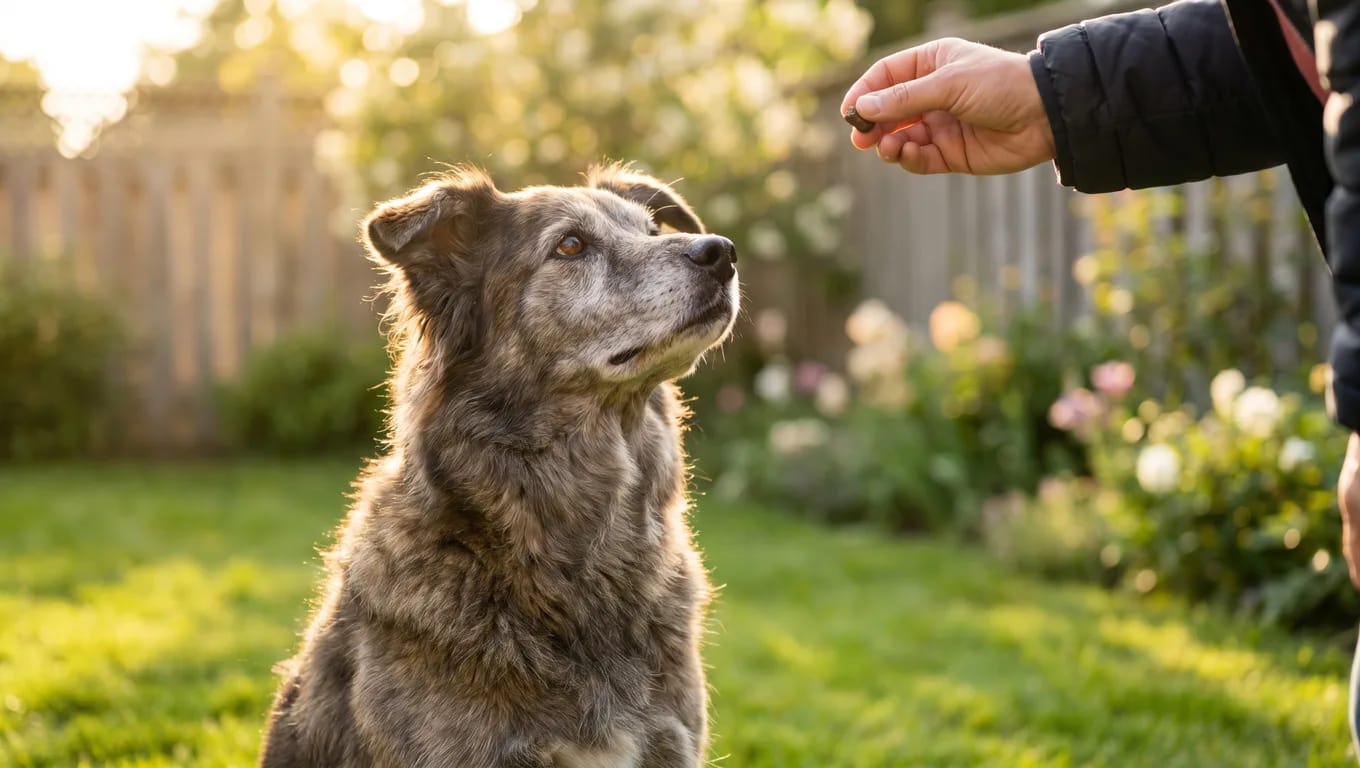
4Brush Up the Basics With Treats
Start with simple, useful behaviors, rewarding the exact second he gets them right:
- His name or an attention sound, so he looks at you when you need him to.
- Sit, a calm way to ask for things instead of jumping.
- Coming when called, the behavior that gives him the most security (and you the most peace of mind).
- Loose-leash walking, built up little by little and without yanking.
Even if you suspect he already knows one of these, run through it with treats. That way you find out what he truly knows and, along the way, teach him that paying attention to you is worth his while.
Jot down two or three concrete goals for the first month (for example: coming when called inside the house, not jumping on guests, and tolerating the muzzle or the brush). Having clear, small goals heads off frustration and lets you see progress, which with an adult is sometimes subtler than with a puppy.
Techniques That Work at Any Age
The foundation for training an adult dog is the same as with any other dog: positive reinforcement, rewarding what you want to see more of so it gets repeated, instead of punishing what he does wrong. With an adult, and especially an adopted one, this matters even more: he learns without fear, he cooperates because it pays off, and above all he starts associating your presence with good things right when he's still getting to know you. These are the principles that deliver the most, whatever the age.
Positive Reinforcement and Good Timing
Reward the correct behavior the instant it happens, not ten seconds later. Reward late, and you teach him something else. A marker (a short word like "yes!" or a clicker) helps you "snap a photo" of the exact moment he nails it.
Short, Consistent Sessions
It's better to train in five- or ten-minute bursts several times a day than in one long, dragging session. With an adult you can stretch it out a bit more than with a puppy, but the golden rule doesn't change: always end on an easy win, so he's left wanting more.
Patience With Old Habits
Changing a behavior the dog has been repeating for years takes longer than teaching a new one. It's not that the adult learns worse: it's that you first have to "unlearn" the old behavior. Instead of fighting the behavior you don't want, teach him what to do instead and reward that. For example, if he jumps up to say hello, reward sitting; if he pulls on the leash, reward the steps he takes with a loose leash.
Steer clear of punishment-based methods, harsh leash corrections, or yelling, especially with an adopted dog whose past you don't know. You have no idea what bad experiences he carries, and punishment can trigger fear or aggression and break the trust you're trying to build. If intense fears or aggressive reactions show up, don't wing it: call in a professional.
Gradual Socialization, Even as an Adult
An adult dog who is under-socialized or fearful hasn't missed the boat: he simply needs more patient work at his own pace. Expose him positively and without pressure to people, balanced dogs, environments, and noises, always letting him be the one to approach and rewarding calm. Never force him or drag him toward something he fears. If his fear is serious, this is the territory of a trainer or a veterinary behaviorist.
Common Mistakes When Training an Adult Dog
When something gets stuck, it's almost always for one of these reasons, and not because of a dog "who just doesn't learn anymore":
- Expecting results overnight. Retraining ingrained habits takes weeks. Consistency always beats rushing.
- Not giving him time to settle in, especially if he's adopted. Asking for obedience while he's still scared only creates frustration.
- Repeating the cue over and over ("come, come, come") instead of saying it once, waiting, and rewarding the win.
- Rewarding late or with something that doesn't motivate him, which lets the learning go cold.
- Falling back on punishment when something goes sideways, damaging the bond that makes everything else possible.
When to Sign Up for a Class
You can start everything in this guide at home today, but a good obedience class speeds the process up a lot, and with an adult dog that really shows. A qualified trainer helps you read your dog, fine-tune your reward timing, and work on obedience around real distractions, something that's nearly impossible to recreate in your living room. And if your dog carries intense fears, reactivity, or any behavior that worries you (very common in adopted dogs with a rough history), a professional is the best investment, and the sooner the better.
Want to start training your adult dog off on the right foot? You can find and book an obedience class with a qualified trainer near you on Canlyo, and build the relationship you both deserve, together, at any age.
So the next time someone hits you with the old-dog-new-tricks line, you'll know exactly what to think. An adult dog isn't a failed project or a lost cause: he's a companion with experience, with personality, and with every desire to understand you. Give him routine, patience, and treats at just the right moment, and you'll find that you not only can train an adult dog, but that few things will give more meaning to the time you spend together.