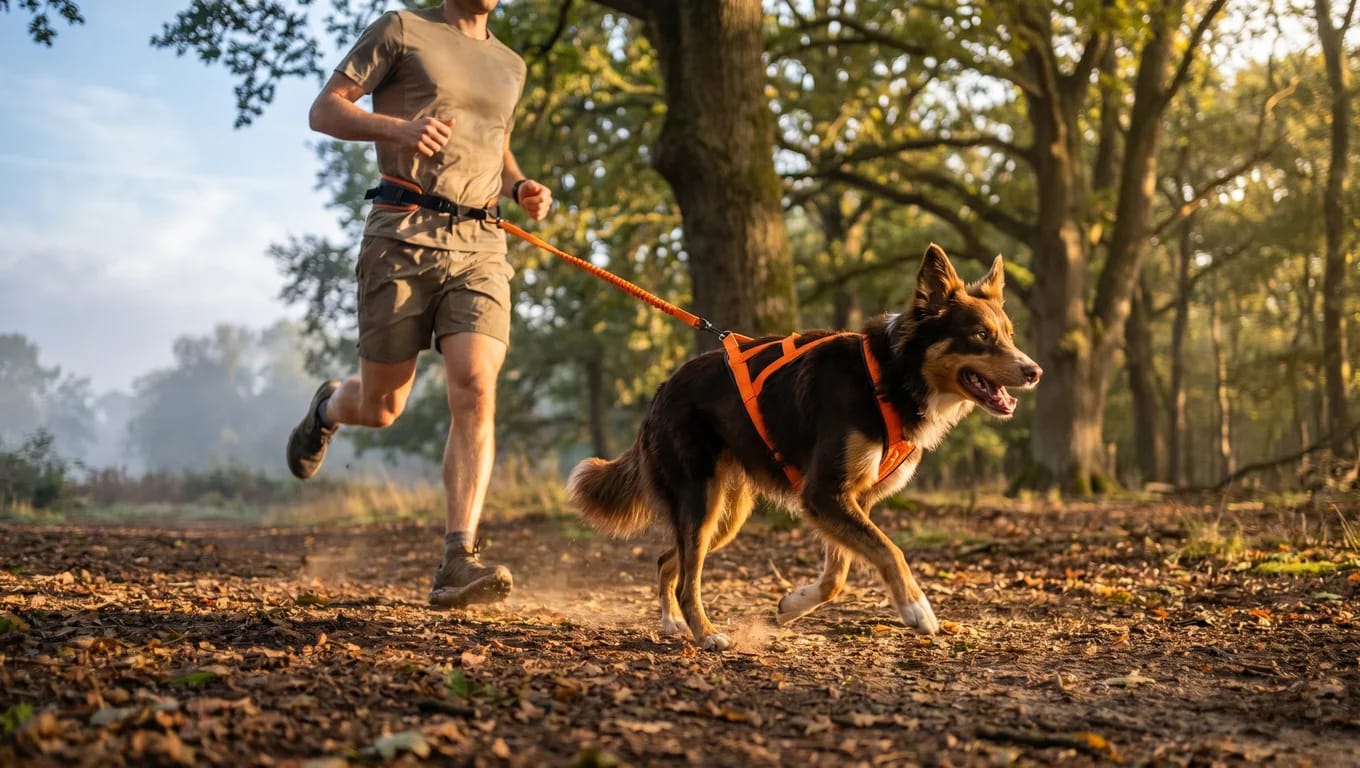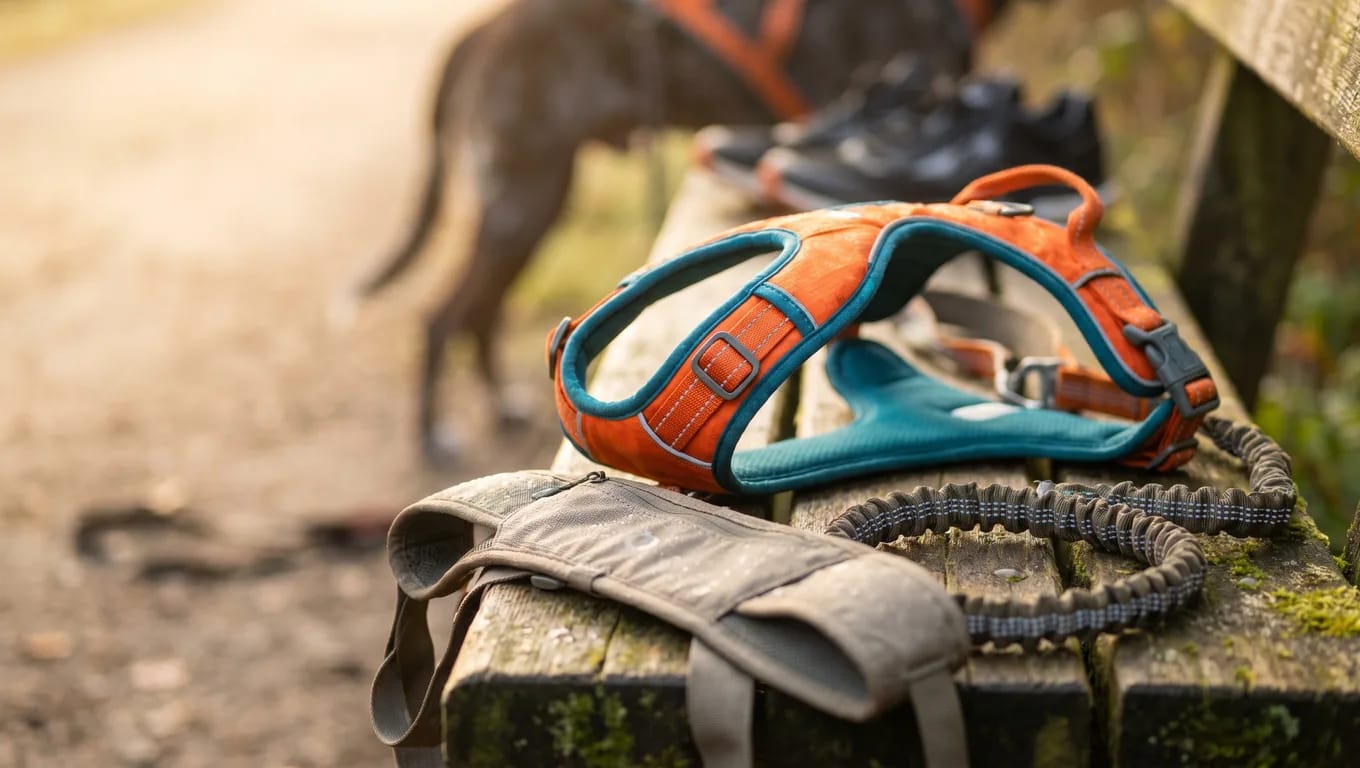
Stand in any pet shop and you will find a wall of harnesses, none of which are built for what you are about to do. The padded no-pull harness that keeps your dog calm on the sidewalk is, in canicross terms, exactly the wrong tool. The sport runs on three purpose-made pieces working as a system: a pulling harness on the dog, a wide belt around your hips, and a stretchy line between the two. Get that trio right and you stop noticing the gear at all. Get it wrong and you spend the whole outing fighting chafe, slipping straps, and a line that snaps you forward on every surge.
This is a buyer's guide, not a sport primer. If you are still deciding whether canicross is for you, start with the basics of the sport and the health checks first. If you already know you want in and you are staring at a checkout page wondering what is worth your money, this is for you. We will break down the three essentials and how to fit each.
What canicross gear do you actually need?
The honest answer is short. You need three things, and you can ignore almost everything else for the first few months.
| Essential | Worn by | Its one job |
|---|---|---|
| Canicross dog harness | The dog | Spread the pulling force safely across chest and shoulders |
| Canicross belt | You | Carry that force on your hips, hands-free, without hurting your back |
| Canicross leash (bungee line) | Connects you both | Absorb the shock of surges so neither athlete gets jolted |
That is the full kit. A water bottle, a head torch, and trail shoes with grip are sensible additions, but they are not the system. The harness, the belt, and the bungee line are. Buy those three correctly and you are ready to run.
You do not need to spend a fortune to start. Solid entry-level canicross gear for one dog and one human typically lands in a sensible mid-range bracket, well below the cost of a single pair of premium running shoes. The expensive trap is buying the wrong thing twice, not buying good gear once.
The canicross dog harness: the piece that matters most
If you only obsess over one purchase, make it this one. The canicross dog harness is the contact point between your dog's body and every bit of pulling force, repeated thousands of times per run. A poor one rubs the skin raw, restricts the shoulders, or loads the throat. A good one disappears.
Why a walking harness will not do
The harnesses sold for everyday walks are designed to discourage pulling, often by tightening across the chest or steering the dog sideways when it leans. In canicross, pulling is the entire point, so that is exactly backwards. A pulling harness makes leaning into the load comfortable and directs that force straight back along the dog's spine to the line. A no-pull or flat-collar setup can choke the dog or pinch the front legs.
What separates the best canicross harness from the rest
When you compare models, you are really comparing how well they handle four things:
- Load path. The pull should travel along the back to an attachment point low at the base of the spine, so the line runs cleanly back to you. A high or off-center attachment twists the harness under load.
- Throat clearance. The neck opening must sit well forward of the windpipe and never tighten under tension. Pressure belongs on the breastbone and shoulders, never the throat.
- Shoulder freedom. The straps must clear the points of the shoulders so the front legs reach forward freely. A harness that crosses the shoulder blades shortens the stride.
- Padding and breathability. Soft, sweat-friendly padding where the webbing meets the body prevents the friction sores that end seasons early.
You will see two broad styles. X-back or H-back harnesses distribute load along the full back and suit dogs built to run long and pull hard, but they need a longer-backed dog to sit correctly. Short or half harnesses stop around the mid-back and fit a wider range of shapes, including deep-chested dogs. Neither is universally the best canicross harness; the best one fits your dog's frame.
How to fit a canicross harness
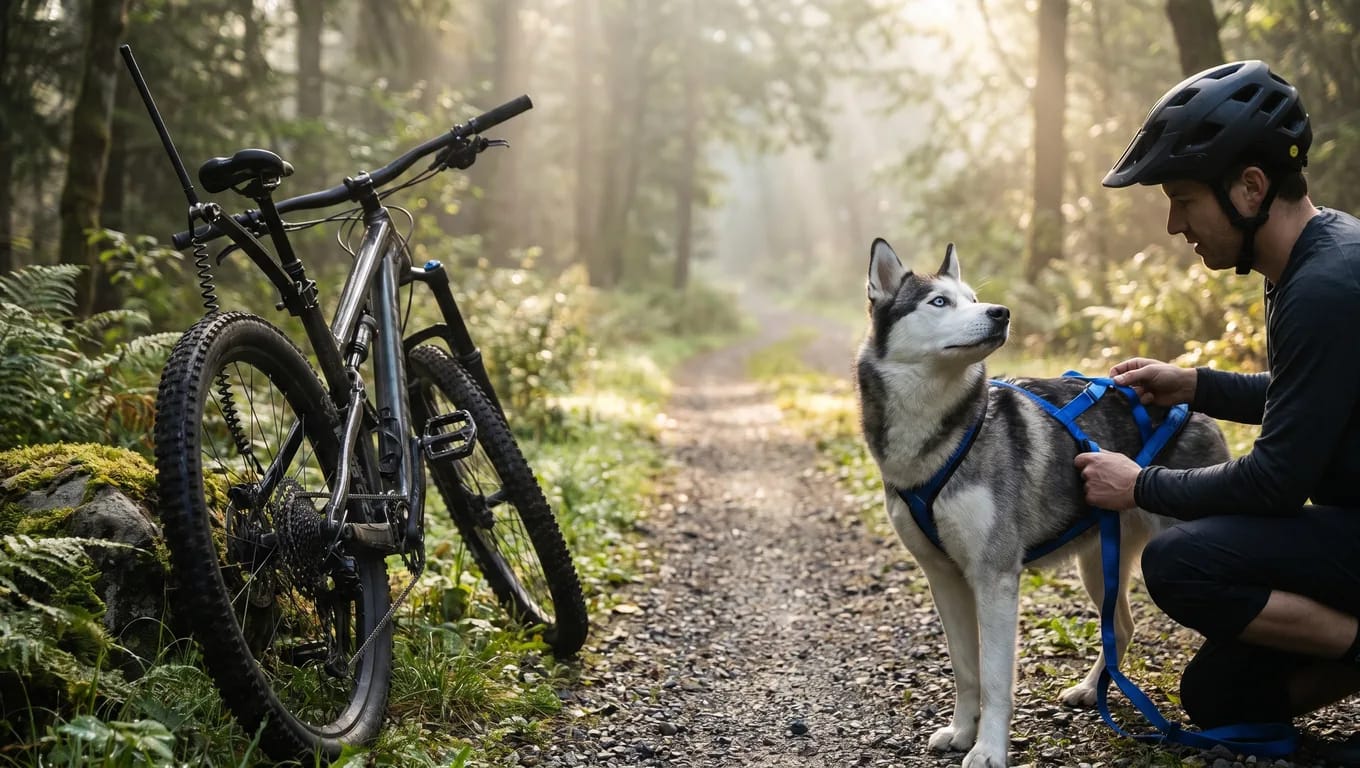
Fit beats brand every time. Measure your dog before you buy, follow the maker's size chart rather than guessing, and check these points with the harness on:
- Neck opening. It should slip over the head without forcing, then sit forward on the chest, clear of the throat. Two fingers should pass under the strap easily.
- Chest and girth. Snug but not tight. You want to slide a flat hand under the side straps with mild resistance, no gaping and no compression.
- Length. With a back-attachment harness, the rear point should reach roughly to the base of the tail, not dig into the spine or ride up the back.
- The load test. Clip the line, take up gentle tension, and watch from the side. The harness should stay put, the attachment should pull straight back, and nothing should creep toward the throat or pinch behind the legs.
Dogs change shape. A puppy that has just finished growing, a dog that gains or loses condition, or a dog mid-coat-blow can all shift a fitting point. Re-check the fit every few weeks early on, and any time the run seems to bother your dog. Recurring rubs or sores almost always mean the harness, not the dog, is the problem.
The canicross belt: where the pull lands on you
The canicross belt is the unsung hero of the kit. Its job is to take the dog's pull off your hands and arms and settle it low on your hips, so you stay balanced and protect your lower back. Run with the line in your hand instead and a single surge can wrench your shoulder or pull you off your feet.
What to look for in a canicross belt
- A low, wide back panel. The belt should sit across your hips and glutes, not your waist, spreading the load across the strongest part of your body. A thin strap that rides up into your waist is uncomfortable and bad for your back.
- Leg loops or a low front attachment. Without leg straps, a hard pull can ride the belt straight up your torso. Leg loops, or a deliberately low front attachment, keep the belt anchored where it belongs.
- A quick-release. The best belts let you detach the dog instantly in an emergency with one pull of a buckle. On any belt you trust at speed, this is close to essential.
- The right fit range. Belts are sized; check the hip range, account for cold-weather layers, and cinch firmly without pinching.
A bottle pocket or a couple of loops for bags and keys are useful, since the point of the belt is to run hands-free, but do not let pocket count distract you from the load-bearing basics above. A well-positioned belt should never hurt; if it digs in, twists, or drags your posture backward, it is the wrong size or design, not something to push through.
The canicross leash: a bungee line, not an ordinary lead
The third essential is the canicross leash, and the word "leash" undersells it. This is a bungee line: webbing with an integrated elastic, shock-absorbing section between you and your dog. It smooths out the constant micro-jolts of a dog accelerating, slowing, and surging, so the force reaching your hips is a gentle, elastic tug rather than a series of jerks. That protects your back and your dog's joints and keeps you both in rhythm.
Why elasticity and length both matter
- The stretch protects the joints. A non-elastic line transmits every surge directly into your spine and the dog's shoulders; the bungee section absorbs those spikes. This is the core reason an ordinary lead is unsafe for the sport.
- Length is both regulated and practical. Canicross lines come in a sport-specific length, usually measured fully stretched, so the dog runs out front with room to work but never so far that you lose contact or the line drags on the ground. Most race rules also cap the stretched length, so if you might ever enter an event, buy a line that complies from the start.
- Reflective and hard-wearing. Early mornings and dark evenings are prime canicross hours. A line with reflective stitching and tough, abrasion-resistant webbing earns its place.
Matching the line to your dog
A heavier, harder-pulling dog wants a firmer, more progressive bungee that does not bottom out under a strong surge. A lighter dog is better served by a softer stretch that cushions without feeling dead. Many lines state a suitable weight or pulling range; use it. A line tuned for a 40 kg sled dog will feel like a steel cable behind a 10 kg spaniel.
Running two dogs is a different setup: a single line that splits into two with a neckline joining the dogs, plus extra fit and training considerations. If you are starting out, master one dog on one line first. The single-dog kit here is the right place to begin.
How to choose your first canicross gear without overspending
Pulling the three pieces together, here is a sane way to spend your first budget.
1Buy the harness to fit, not to a brand
Measure your dog, follow the size chart, and buy from a retailer with easy exchanges. The right canicross dog harness for your dog beats the famous name on someone else's.
2Buy a belt with a wide hip panel and leg loops
Choose your size honestly and prioritize the low back panel, leg loops, and a quick-release. A canicross belt you forget you are wearing is the goal.
3Buy a bungee line matched to your dog's size
Pick a canicross leash with a proper shock-absorbing section, a stretched length that suits the sport and any races you might enter, and a bungee firmness matched to your dog's weight and drive.
4Run, then refine
Resist buying accessories before your first month of running. Real outings tell you what you need: a head torch for the dark, a stronger bungee for an enthusiastic puller, a second harness for a dog between sizes. Let the running, not the marketing, write your shopping list.
The fastest way to get your gear dialed in is to run with people who already have theirs sorted. A beginner-friendly canicross class gives you experienced eyes on your harness fit, a chance to feel different belts and lines before you commit, and a trainer who can match the kit to your dog. Find and book a canicross class near you on Canlyo, and turn that wall of confusing options into one setup that works.
Good canicross gear is not complicated once you strip it back: a harness that fits your dog's body, a belt that sits low on your hips, and a bungee line that soaks up the surges. Spend your attention on fit over brand, buy the three essentials well the first time, and the equipment fades into the background, leaving you and your dog free to do the one thing you came out there for: run.