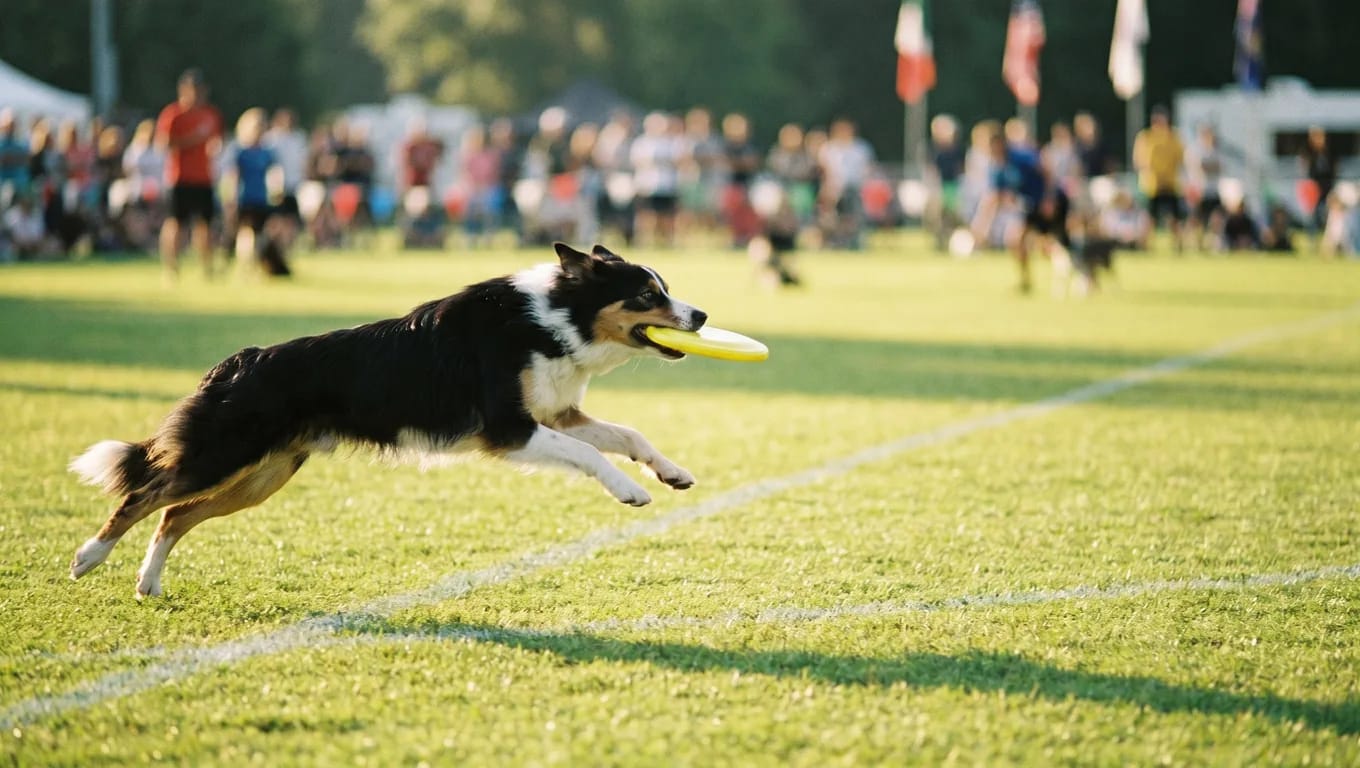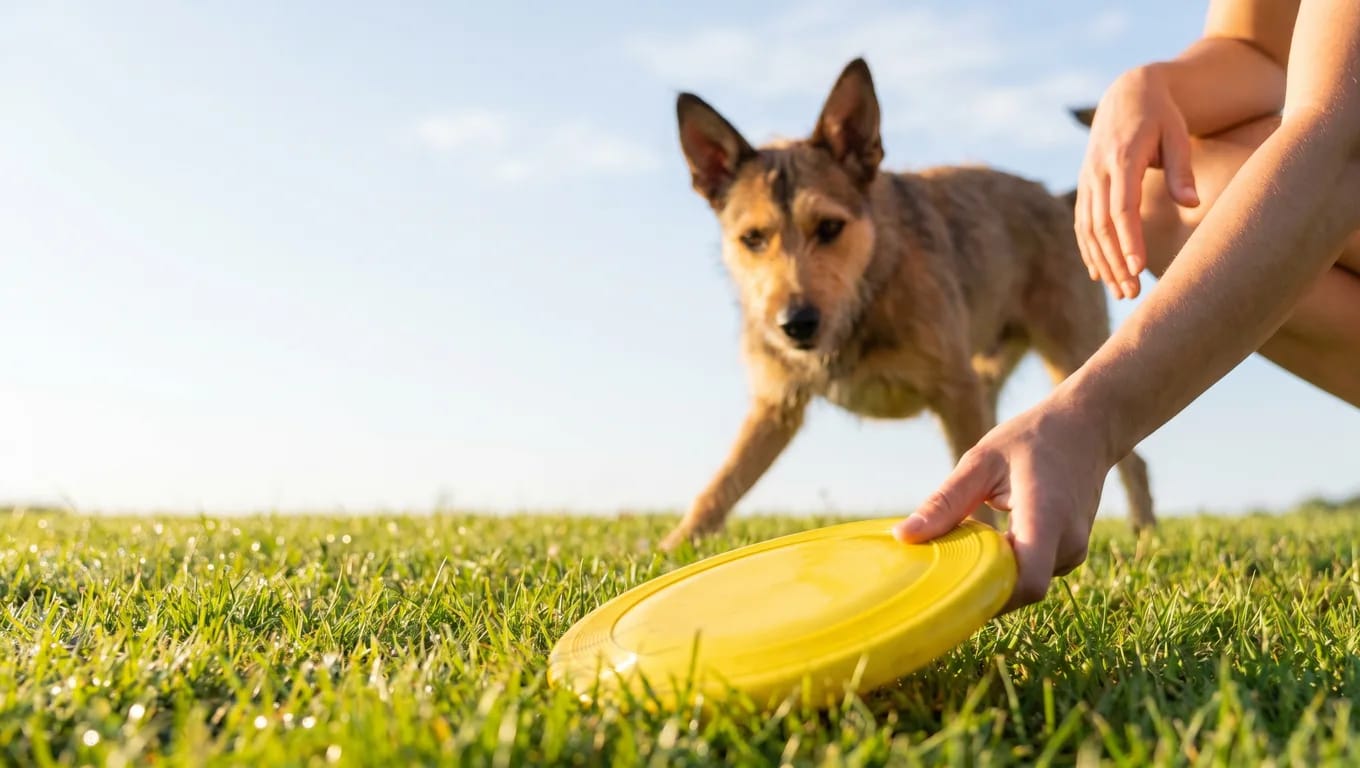
The first time a dog reads a frisbee out of the air and snaps it shut, you hear it before you fully register it: a soft thud of plastic meeting jaw, the back legs gathering for the catch, the whole dog lit up over a piece of spinning plastic. It looks like pure instinct. It almost never is. The dogs that make it look easy were built one tiny rep at a time, usually by an owner standing two feet away, rolling a disc across the grass while their puppy worked out that this round thing was the best toy in the world.
If you have ever lobbed a disc across the yard and watched it bonk your dog on the nose while they stared at you, confused, this guide is for you. We are going to build the catch from the ground up, the way I teach it with my own students, so that playing frisbee with your dog becomes a game you both actually look forward to.
Why most dogs miss the disc at first
A frisbee is a strange object for a dog. A ball bounces and rolls in a way that maps neatly onto chasing prey. A disc hovers, wobbles, dips, and changes speed in the air. Dogs are not born knowing how to track that flight path, and a lot of "my dog won't catch" really means "my dog has never been taught to read a disc."
There are usually three things going on when a dog keeps missing:
- The disc is scary or boring. A hard, rigid disc that hurts when it lands teeth-first will teach a dog to duck, not catch.
- The throws are too hard, too high, or too fast. A disc sailing over their head gives them nothing to do.
- The dog never learned the disc is valuable. If the frisbee only appears for thirty frantic seconds before going back in a drawer, it never becomes the thing your dog loves.
The fix for all three is the same: slow down, lower your expectations to almost nothing, and make the disc the most rewarding object in your dog's day. There is no trick beyond that. Every clean catch you have admired sits on top of those three things.
Disc dog, also known as frisbee dog, is the sport of dogs catching and retrieving flying discs. You do not need to compete to enjoy it. The same foundations that build a competition dog also build a happy backyard catcher, so everything in this guide works whether your goal is a podium or a relaxed game in the park.
Choosing a safe disc for dogs
Before you teach a single throw, get the right equipment. A standard hard plastic frisbee from a sporting goods store is made for human hands, not dog mouths. It can chip teeth, bruise gums, and turn a confident dog cautious in one bad catch.
Look for a purpose-built frisbee for dogs:
- Soft, flexible material. A good dog frisbee flexes when you bend it and has some give against teeth. Rubber and soft-bite nylon or fabric discs are gentle on the mouth.
- The right size and weight. Match the disc to your dog. A Border Collie can handle a standard competition-weight disc; a small terrier needs something lighter and smaller.
- Bright, contrasting color. Dogs see blue and yellow best, so a vivid disc against green grass is far easier for them to track than white or red.
Keep two or three identical discs in rotation. This matters more than people expect. When your dog brings one back, you can immediately throw the second, so the game never stops while you pry a disc from a happy mouth.
Never let your dog catch a disc on a hard surface like concrete or asphalt, and avoid high, vertical leaps until they are an adult with sealed growth plates. Disc work is athletic, and bad landings cause real injuries. Keep early sessions on grass with low, flat throws.
How to teach a dog to catch a frisbee, step by step
Here is the progression I use. Do not rush it. Each step should be genuinely easy and fun before you move on, and you can spend several short sessions on a single step. Two or three minutes, a few times a day, beats one long, frustrating session every time.
1Make the disc the best toy in the world
Before the disc ever flies, it has to mean something. Use it as a food bowl for a few meals, scattering kibble inside it so your dog learns to love nosing around it. Play tug with it, low to the ground, and let your dog win. Wiggle it on the floor and reward any interest with praise and a treat.
You are not asking for a catch yet. You are building value. A dog who lights up when the disc comes out is a dog who will work hard to chase it.
2Teach the take and the give
Hold the disc still in your hand and encourage your dog to grab the edge. The moment they do, mark it ("yes!") and reward. Then trade the disc for a treat so giving it back is also rewarding. You want two clean behaviors here: a confident take and a happy give, with no guarding and no keep-away.
Practice this until your dog will take the disc from your hand reliably and let go on cue. This is the quiet foundation that prevents the single most common frisbee problem, the dog who catches and then sprints off to chew it in the corner.
3Roll the disc like a wheel
This is the step that changes everything, and the one most people skip. Turn the disc on its edge and roll it across the grass like a wheel, away from your dog, slow and straight. A rolling disc is easy to chase and easy to catch, because it stays on the ground where your dog's prey drive already lives.
Start with short rollers right in front of you. Cheer when your dog pounces on it, and reward the grab. Gradually roll it a little faster and a little farther. Rollers teach your dog to track a moving disc, commit to it, and close their mouth on it, all without a single jump. Most dogs nail the rolling catch within a few sessions, and that success is what gives them the confidence to start catching in the air.
4Add short, flat throws
Now you put the disc in the air, but barely. Kneel or crouch close to your dog and toss the disc low and flat from just a few feet away, aiming so it floats right toward their mouth at chest height. The goal is a throw so easy it is almost impossible to miss.
A few tips for these first dog frisbee throws:
- Throw with the wind at your back so the disc flies flat and predictable.
- Keep it level, not arcing up. A disc dropping gently into the mouth beats a disc sailing overhead.
- Use a soft, slow throw. Speed comes much later, after the catch is solid.
When your dog plucks one cleanly out of the air, make a huge deal of it: high voice, hands clapping, a jackpot of treats or a quick game of tug. That first airborne catch is the moment everything has been building toward, and your dog should feel it land.
5Build distance and height gradually
Only once your dog is catching easy, flat throws should you start adding distance and a little arc. Take one step back at a time. If your dog starts missing, you have moved too fast, so come back to where they were succeeding and rebuild.
Let your dog tell you when they are ready to leap. Confident dogs start timing their own jumps naturally as the throws get longer. Encourage that, but never force height, and keep landings soft on grass.
A realistic timeline for teaching frisbee to your dog
Every dog is different, but here is roughly how the journey unfolds for a healthy, motivated dog working in short daily sessions.
| Phase | What you are working on | Typical timeframe |
|---|---|---|
| Building value | Disc as food bowl, tug, take and give | Week 1 |
| Ground game | Rolling discs, tracking, committing to the catch | Weeks 1-2 |
| First air catches | Short, flat, easy throws caught in the mouth | Weeks 2-4 |
| Distance and confidence | Longer throws, the dog timing its own small jumps | Month 2 and beyond |
If your dog plateaus, the answer is almost always to make it easier, not harder. Drop back a step, lower the throw, shorten the distance, and rebuild the win.
Keeping frisbee fun and safe
A frisbee session should leave your dog tired and happy, not sore and overstimulated. A few habits keep dog frisbee a lifelong joy rather than a short-lived craze.
- End while your dog still wants more. Stop after a few great catches, not after the tenth tired miss.
- Warm up and cool down. A minute of trotting and easy rollers before big throws protects muscles and joints.
- Watch the surface and the heat. Grass over pavement, shade over midday sun, and plenty of water.
- Check the disc regularly. Toss any disc with cracked or sharp edges.
- Stop if your dog limps or hesitates. Soreness is a signal, not something to push through.
Done right, playing frisbee with your dog becomes one of the easiest ways to give them real exercise, a job for their brain, and a few minutes of pure partnership with you every day.
Ready to take it further? A good beginner disc dog class gives you expert eyes on your throws, a safe space for your dog to build skills, and a few fellow handlers to learn alongside. Find and book a disc dog class near you on Canlyo, track your dog's progress between sessions, and turn those backyard catches into a sport you both love.