Your dog is bouncing at the front door, claws skittering on the floor, leash trailing, while you fumble the clip on with one hand and block the doorway with the other to stop a bolt into the hallway. One word would settle the whole scene. "Sit." That is the quiet power of basic obedience: not blind submission, but a shared vocabulary that turns a chaotic moment into a calm, cooperative one.
This is your hands-on guide to how to train a dog to sit and the three commands that naturally follow it: stay, down, and heel. Together these four make up the core of everyday manners. You do not need a clicker, special gear, or any kind of dominant attitude. You need a handful of soft treats, a few quiet minutes a day, and a little patience.
What Are the Basic Commands for Dogs?
If you have searched for the basic commands for dogs, you will see the same short list almost everywhere, and for good reason. These few behaviors cover the vast majority of daily situations:
- Sit to settle and wait politely (at doors, before meals, when greeting people)
- Stay to hold position until you release them (essential for safety and self-control)
- Down (lie down) to relax for longer stretches and to defuse over-excitement
- Heel to walk attentively at your side through busy or distracting places
Two more core skills sit alongside these but deserve their own guides. Recall (coming when called) keeps your dog safe off-leash, and you can work through it in our dog recall training guide. Loose-leash walking, where your dog strolls on a relaxed lead without pulling, is a separate skill from the formal heel covered here, and we tackle it in our loose-leash walking guide. This guide stays focused on sit, stay, down, and heel.
Every command in this guide is taught with positive reinforcement: you mark the behavior you want and reward it, rather than forcing or correcting your dog into position. A dog that chooses to sit because it pays off learns faster, and far more happily, than one shoved into place.
Before You Start: Set Yourself Up to Win
A few minutes of preparation will save you weeks of frustration.
- Use small, high-value treats. Pea-sized pieces of chicken, cheese, or soft training treats keep your dog keen without filling them up. You will be paying out a lot at first.
- Pick a marker word. A crisp "yes!" the instant your dog does the right thing tells them precisely which action earned the treat. Timing matters more than the treat itself.
- Train in short bursts. Two or three sessions of two to five minutes each beat one long, frustrating slog. Stop while your dog still wants more.
- Start somewhere boring. A quiet room with no dogs, visitors, or toys lets your dog focus entirely on you. Distractions come later, on purpose.
- One cue, said once. Say the word a single time. Repeating "sit, sit, sit" teaches your dog that the word is just background noise.
How Long Does It Take to Teach Basic Commands?
Owners always want a timeline, so here is an honest one. The first response often appears within a single session; reliability around real distractions is the longer game.
| Command | First reliable response | Solid in distractions |
|---|---|---|
| Sit | 1-3 sessions | 2-4 weeks |
| Down | 2-5 sessions | 3-5 weeks |
| Stay | 1-2 weeks | 1-3 months |
| Heel | 2-4 weeks | 2-6 months |
Treat these as rough guides, not deadlines. A bouncy adolescent and a calm senior will not move at the same pace, and that is completely normal.
How to Train a Dog to Sit
Sit is the foundation, the easiest win, and the gateway to everything else. Here is exactly how to train a dog to sit using a food lure, no pushing on the rear required.
1Lure the Sit
Hold a treat right at your dog's nose. Slowly raise it up and back over their head, toward the tail. As the nose follows the treat up, the rear naturally drops to the floor. The moment their bottom touches down, mark with "yes!" and feed the treat.
2Add the Word
Once your dog is folding into a sit smoothly with the lure (usually after five to ten reps), say "sit" once, just before you move the treat. You are teaching the word to predict the action. Mark and reward every success.
3Fade the Lure
Now make the same hand motion with an empty hand, then reward from your other hand or a pocket. Your dog learns that the gesture and the word, not the visible food, are what earn the treat. This step stops you from being stuck waving a treat forever.
If your dog jumps up at the treat instead of sitting, your hand is too high. Keep it low and close to the nose so following it folds them down rather than tipping them up.
4Practice Everywhere
Ask for a sit before meals, before the leash goes on, before you throw a toy, at the curb before crossing. Real life becomes your training ground, and the sit becomes a default polite behavior.
How to Train a Dog to Lay Down
Down is a natural next step from sit, and it is the command that helps an over-aroused dog actually settle. Here is how to train a dog to lay down without any wrestling. (A quick note for the grammar-minded: "lay down" is the common search phrase, though "lie down" is the technically correct command.)
1Lure to the Floor
Start with your dog in a sit. Hold a treat at their nose and lower it straight down to the floor between their front paws, then slowly slide it a little forward along the ground, like drawing an "L." Most dogs follow the treat down into a full down. The instant their elbows touch the floor, mark and reward.
2Name It and Fade the Lure
Once the motion is reliable, add the cue "down" just before you lure, exactly as you did with sit. Then fade to an empty-hand signal, pointing toward the floor, and reward from the other hand.
3Build Duration
Down is most useful when your dog can hold it. Once they drop on cue, wait one second before marking, then two, then five, stretching the time before the reward. Feed a few treats in a row while they stay down to teach that staying put is what pays.
Some dogs resist lying down on cold, hard, or slippery floors, where the position feels vulnerable. If yours stalls, practice on a rug, a mat, or grass first. You are not facing a stubborn dog, just an uncomfortable surface.
How to Train a Dog to Stay
Stay teaches impulse control and underpins safety in dozens of everyday moments. The secret to how to train a dog to stay is to grow difficulty along three separate dials, one at a time: duration (how long), distance (how far you go), and distraction (what is happening around you).
1Start With a Release Word
Before you teach stay, pick a release word such as "okay" or "free" that means "you can move now." Stay only has meaning if there is a clear end to it.
2Reward the Pause
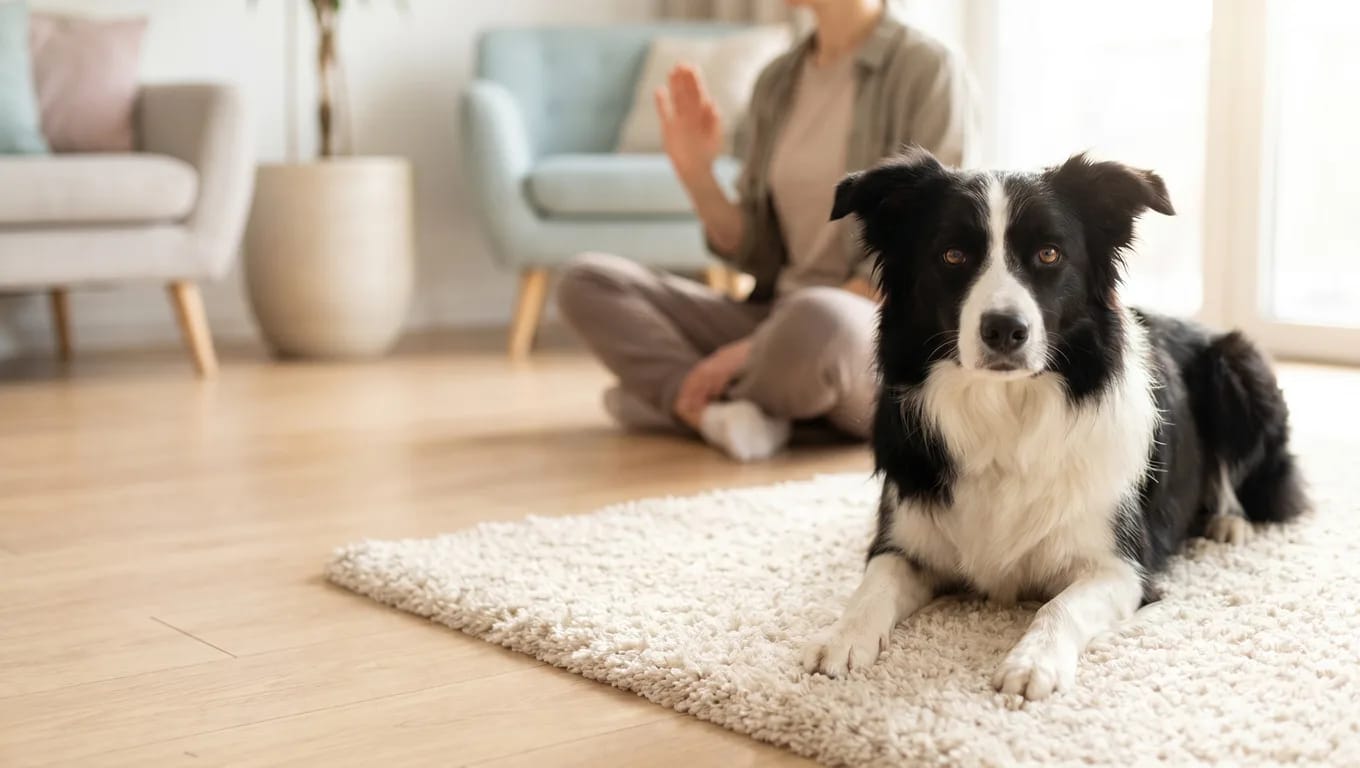
Ask your dog to sit or lie down. Wait one second, mark, reward, then release with your word. Build the wait second by second, adding the cue "stay" with a flat palm once your dog holds for a few seconds. Always end the stay with your release word, not by letting them drift off on their own.
3Add Distance, Then Distraction
Take one step back, return, reward, release. Slowly increase how far you move. Only once distance is solid do you add distractions: someone walking past, a toy on the floor, a knock at the door. If your dog breaks, you have simply asked for too much too soon. Make it easier and rebuild.
The golden rule of stay: return to your dog to reward, rather than calling them to you. If you always call them out of a stay, they learn to anticipate and break early. Reward the holding, release separately.
How to Train a Dog to Heel
Heel is the most advanced of the four because it asks for sustained attention in motion. A formal heel means your dog walks attentively in a set position at your side, head up, matched to your pace, which differs from general loose-leash walking, where any non-pulling spot on a relaxed lead is fine. Here is how to train a dog to heel in focused bursts.
1Reward the Position
Decide which side you want (left is traditional). With your dog standing beside you, feed a treat at the seam of your trouser leg, right where you want their head. Do this a few times standing still so your dog learns that this exact spot is a paying position.
2Take One Step
Say "heel," take a single step forward, and reward at your leg if your dog stays in position. Then two steps, then three. Keep your treat hand at your side so your dog learns to track your leg, not your face or a raised hand.
3Add Turns and Pace Changes
Once your dog holds a straight line, add gentle turns and changes of speed. Turning into your dog, slowing, and speeding up all teach them to track you rather than march ahead on autopilot. Keep these sessions short; heel is mentally tiring.
4Release to Sniff
Heel is a job, not the whole walk. Use your release word frequently to let your dog go sniff and be a dog. Alternating short heel sets with free sniffing keeps heel sharp and your walks enjoyable for both of you.
Common Mistakes With Basic Commands
Even motivated owners trip over the same handful of errors. Watch for these.
- Repeating the cue. Saying the word over and over teaches your dog to ignore the first nine repetitions. Say it once, then help them succeed.
- Fading rewards too fast. Thin out treats only once the response is rock solid, and keep occasional surprise rewards for life.
- Training only at home. A dog that sits in the kitchen but not at the park has not generalized the behavior. Practice each command in many places.
- Skipping the release. Without a clear release word, stay and heel have no defined end, so your dog fills the gap by guessing.
- Long, late sessions. A tired or overexcited dog cannot learn well. Keep sessions short, upbeat, and end on a win.
Should You Train Alone or in a Class?
You can absolutely teach all four commands at home, and most of the early work is best done there in quiet. But proofing these behaviors around other dogs and people is exactly where a good obedience class earns its keep. A class gives you a controlled space full of calm, distance-managed dogs to practice around, plus a trainer who can catch the timing slips that quietly hold your dog back, such as marking a beat too late or luring with your hand too high.
Ready to put sit, stay, down, and heel on cue with a trainer in your corner? Find and book a beginner obedience class near you on Canlyo, track your dog's progress between sessions, and turn these basic commands into reliable everyday manners.